5 Best Hotel Price Comparison Sites for Finding Cheaper Stays
Hotel rates can look completely different depending on where you search: the same room may have one price on the hotel’s website, another on a booking platform and a third elsewhere.
Hotel rates can look completely different depending on where you search. The same room may be listed at one price on the hotel’s website, another on a large booking platform, and a third through a smaller online travel agency. That is why using one of the best hotel price comparison sites should be your first step before booking.
These tools search multiple hotel websites and display their offers in one place. They save time and help you compare location, cancellation terms, ratings, and extras. However, the cheapest headline price is not automatically the best choice.
This guide compares Google Hotels, KAYAK, trivago, HotelsCombined, and Tripadvisor, including their strengths, weaknesses, and best uses.
Quick Comparison of the Best Hotel Price Comparison Sites
| Site | Best for | Strongest feature | Price alerts | Main limitation |
|---|---|---|---|---|
| Google Hotels | Fast, map-based research | Excellent location view and flexible date browsing | Yes, availability varies by search and device | Fewer advanced travel-planning tools |
| KAYAK | Detailed filtering and price tracking | Searches hundreds of travel sites | Yes | Results and offers can feel crowded |
| trivago | Comparing rates for one hotel | Clear side-by-side provider offers | Available in supported markets | Headline prices need careful checking |
| Hotels Combined | Broad international searches | Simple metasearch across major providers | Limited compared with KAYAK | Less useful for reviews and trip research |
| Tripadvisor | Reviews plus price comparison | Huge volume of traveler feedback | Not its main strength | Review scores can distract from rate details. |
No platform finds the lowest price every time. Membership discounts, mobile rates, currency settings, and taxes can change what you see. Compare two metasearch sites, then check the hotel’s direct price.
What Is a Hotel Price Comparison Site?
A hotel price comparison site, also called a hotel metasearch engine, collects rates from hotels and third-party booking websites. Enter your destination, dates, and guests to see matching properties and sellers.
When you select an offer, you are usually redirected to the provider to complete the reservation. That provider may be the hotel itself, Booking.com, Expedia, Agoda, or another online travel agency. The comparison site helps you search, but it often does not manage the reservation afterward.
For changes or refunds, contact the company named on the confirmation.
1. Google Hotels: Best Overall for Fast Comparison

Google Hotels is often the quickest place to begin. Search for hotels in a city through Google, enter your dates, and you will see prices alongside a highly useful map. It combines rates, photos, amenities, reviews, and location information in a clean interface.
Its biggest advantage is context. You can see whether a hotel is near a station, beach, business district, or attraction without opening several tabs. Filters cover price, stars, rating, amenities, and brands.
Flexible-date tools can show whether moving a trip by one night lowers the cost. Google may also offer price tracking for eligible searches when you are signed in.
Pros
Fast and easy to use on desktop or mobile
Strong map for checking neighborhoods and transport links
Displays offers from hotel websites and booking platforms
Useful date and price-tracking tools
Cons
Not every hotel or booking provider appears
Best for: Travelers who want a quick overview of price, location, and availability before narrowing their shortlist.
2. KAYAK: Best for Filters and Price Alerts

KAYAK is a powerful travel metasearch platform that checks hundreds of travel sites. Its hotel search works especially well for people with firm requirements, such as free cancellation, breakfast, parking, a swimming pool, or a minimum guest score.
Results can be sorted by price, review rating, distance, or hotel class. Its map also lets users compare sellers for the same property. KAYAK says its hotel results cover more than two million properties.
Signed-in users can set an alert and receive updates when rates change. This helps when booking months ahead or watching an expensive resort.
Pros
Extensive filters for facilities, neighborhood, and booking conditions
Searches a large range of travel websites
Hotel price alerts can track changes
Verified guest reviews help with quality checks
Cons
Sponsored or recommended listings require attention
Best for: Detail-focused travelers who want advanced filters and ongoing price monitoring.
3. trivago: Best for Comparing Sellers for One Hotel
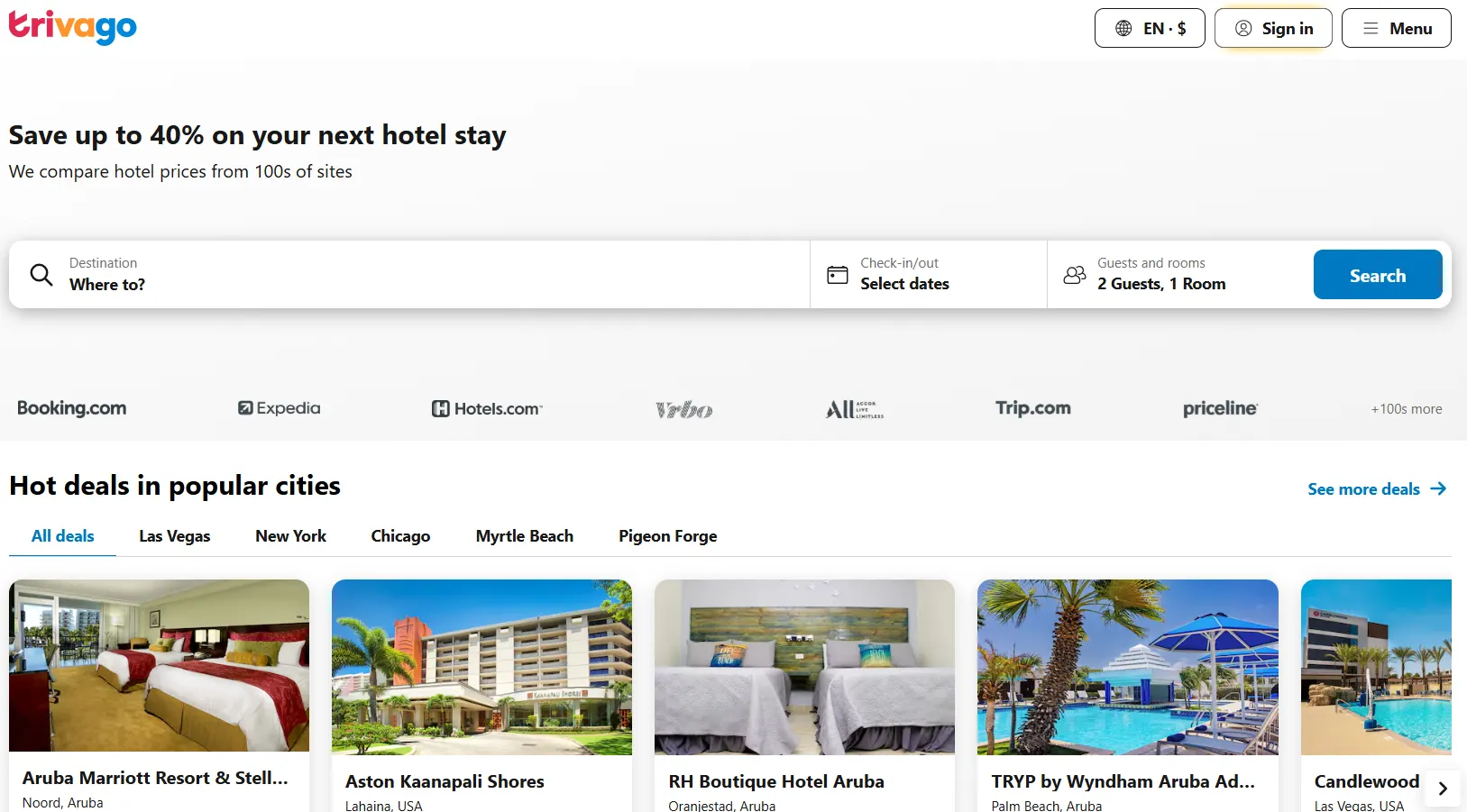
trivago is built around a simple idea: find a hotel, then compare offers from multiple booking websites. It is particularly useful once you already know the property you want but need to choose where to reserve it.
Search results include photos, guest ratings, location, popular amenities, and a selection of rates. Open a property to examine additional offers rather than relying only on the first displayed price. Different sellers may list different room types or cancellation policies.
The interface makes differences easy to spot, but a cheaper offer may exclude breakfast, require immediate payment, or apply to a smaller room. Match the occupancy, bed type, meal plan, and refund terms.
Pros
Focused specifically on accommodation comparison
Easy side-by-side offers for the same property
Useful filters for rating, facilities, and distance
Broad international coverage
Cons
The highlighted offer is not always the best overall value
Best for: Travelers who have selected a hotel and want to compare the available sellers.
4. HotelsCombined: Best for Broad International Searches
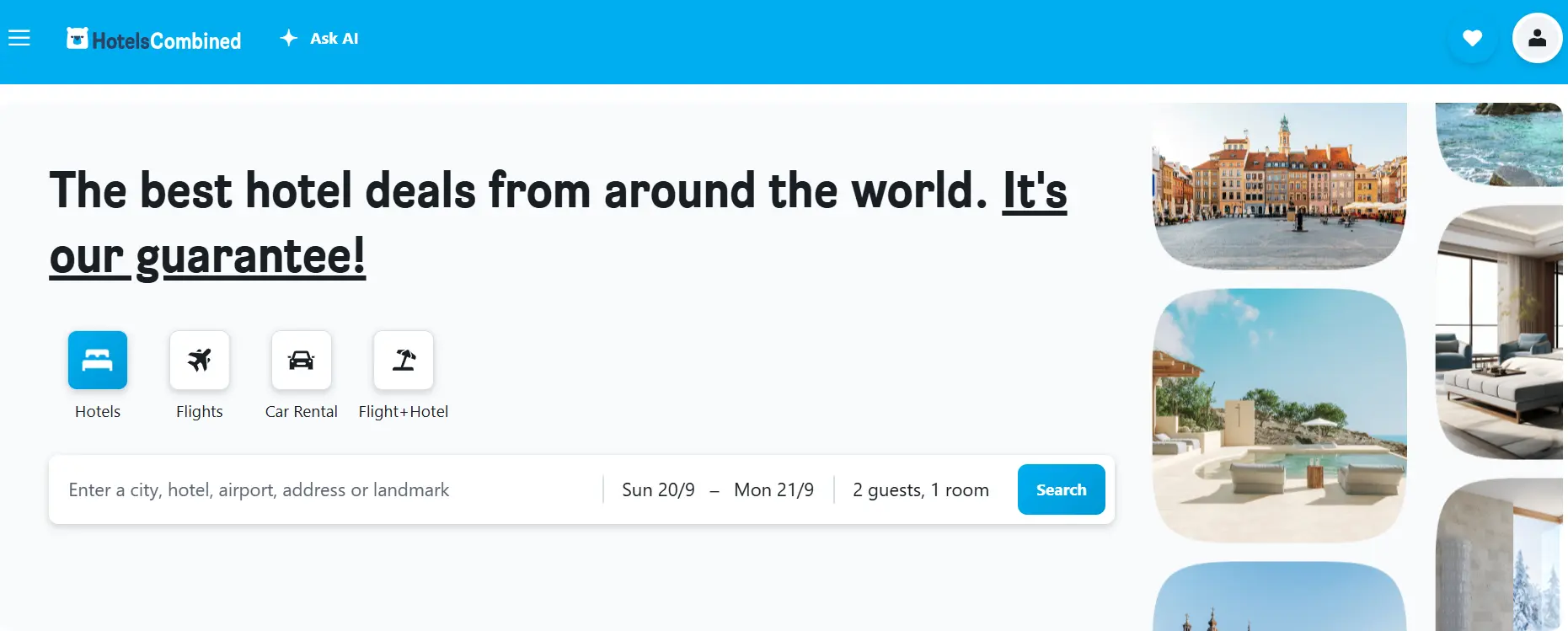
HotelsCombined searches hotel rates from multiple booking partners and presents them in one results list. It is a useful second-check tool, particularly for international destinations where local or regional booking sites may price rooms differently.
You can filter properties by price, rating, hotel class, amenities, and location. Results include guest review scores and a map, while individual hotel pages show offers available through different providers.
HotelsCombined belongs to the same travel group as KAYAK, so inventory can overlap. Still, its interface may organize deals differently and offers a straightforward second search.
Pros
Broad selection of hotels and booking partners
Clean focus on accommodation deals
Helpful filters and map view
Cons
May show similar inventory to KAYAK
Best for: International travelers who want a simple second opinion after checking another comparison engine.
5. Tripadvisor: Best for Reviews and Price Research Together

Tripadvisor combines hotel comparison with one of the largest collections of traveler reviews. It works well when price matters but you also want detailed feedback about cleanliness, noise, staff, breakfast, room condition, and neighborhood safety.
Hotel pages can display offers from multiple booking partners. You can compare those prices while reading recent reviews and viewing traveler photos, which are often more realistic than professional hotel images.
Sort by recent posts, look for repeated complaints, and read comments from travelers whose trip resembles yours. A business traveler and a family may judge the same hotel differently.
Pros
Extensive traveler reviews and guest photos
Hotel prices and reputation appear in one place
Filters for traveler type, rating, amenities, and area
Cons
The page can feel busy because it includes a lot of content
It is not the strongest platform for price alerts
Best for: Travelers who want to judge hotel quality before deciding whether the cheapest offer is worth taking.
How to Compare Hotel Prices Step by Step
Step 1: Search with exact details
Enter the correct dates, number of rooms, adults, and children. Hotels often charge differently based on occupancy, and child age rules vary.
Step 2: Use filters that match your real needs
Filter for location, rating, and essential facilities as well as price. A cheap hotel far from the center may cost more after daily transport.
Step 3: Build a shortlist
Select three to five properties with suitable locations and recent reviews.
Step 4: Compare equivalent rooms
Check the room category, bed setup, occupancy, breakfast, cancellation deadline, and payment timing. Two rates are not comparable if one is refundable and the other is not.
Step 5: Review the final total
Click through to the provider and inspect the checkout page. Look for taxes, resort fees, destination charges, cleaning fees, and currency conversion costs.
Step 6: Check the hotel’s own website
Direct rates may include breakfast, parking, points, a better room, or more flexible changes. Direct booking can also make service easier.
Step 7: Save proof and confirm the reservation
Keep the confirmation and screenshot the room and cancellation conditions. For an important stay, verify the booking with the hotel.
Pro Tips for Getting a Better Hotel Deal
Compare the total stay price. A low nightly rate can hide taxes or mandatory property fees.
Search while signed out and signed in. Member prices may help, but they can also make comparison less clear.
Check another currency. Only do this if your card has low foreign transaction fees and the provider clearly states the charging currency.
Choose free cancellation when practical. You can monitor prices and rebook if the same room becomes cheaper before the deadline.
Look one neighborhood farther out. A hotel near a direct metro line may offer better value than a mediocre property in the tourist center.
Call the hotel for long stays. It may match an online rate or include breakfast, parking, or an upgrade.
Avoid unknown sellers for tiny savings. A small discount may not justify weak support when plans change.
Common Mistakes to Avoid
Do not assume every displayed offer is for the same room. “Standard,” “classic,” and “double” can refer to different sizes and bed arrangements across providers.
Also avoid judging a deal only by its discount label. Compare the current total with other live offers instead of trusting a crossed-out reference price. Finally, check whether payment is due now or at the property, especially when exchange rates could change.
Frequently Asked Questions
Which hotel comparison site is the best overall?
Google Hotels is the best starting point for most travelers because its map, filters, and date tools make research quick. KAYAK is a stronger choice when you need detailed filters or price alerts.
Do hotel price comparison sites charge users?
The five sites in this guide are generally free for travelers to search. They usually earn money from advertising, referrals, or booking partners. Your payment is normally processed by the selected hotel or booking provider.
Why does the price change after I click an offer?
Hotel inventory changes quickly. The comparison site may briefly display a cached rate, or the provider may add taxes and fees later in the checkout process. Always verify the final total before paying.
Is booking directly with the hotel cheaper?
Sometimes. Hotels may offer member rates, loyalty points, free breakfast, flexible cancellation, or room upgrades. Third-party sites can still be cheaper, so compare the full package rather than only the base rate.
Are hotel price comparison sites safe?
The comparison platforms covered here are well-known, but they may send you to outside booking providers. Check the seller’s name, cancellation rules, contact information, and reputation before entering payment details.
Can I cancel through the comparison site?
Usually not. Cancellation is handled by the company that issued the confirmation and charged the booking. Follow the instructions in your reservation email.
When is the best time to compare hotel prices?
Start as soon as your dates are reasonably firm, particularly for major events and peak seasons. If you book a refundable rate, continue checking periodically before the free-cancellation deadline.
Final Verdict
The best hotel search strategy uses comparison sites as research tools, not as a guarantee of the lowest final price. Google Hotels is the strongest all-round starting point, KAYAK stands out for filters and alerts, and trivago is excellent for comparing sellers for a chosen property.
HotelsCombined provides a useful extra check for international stays, while Tripadvisor is best when reviews and traveler photos matter as much as price. Whichever site you use, compare like-for-like rooms, open the final checkout page, and check the hotel’s direct offer before paying. A few extra minutes can save money and prevent an unpleasant surprise at check-in.
Some links on this page are affiliate links. If you book through one we may earn a commission, at no extra cost to you. It never affects our ratings, our rankings, or the price you pay.