5 Best Sites for International Hotels: Where to Book Your Next Overseas Stay
Booking a hotel in another country brings more questions than booking close to home. Is the quoted price final? Can you pay in your own currency?
Booking a hotel in another country brings more questions than booking close to home. Is the quoted price final? Can you pay in your own currency? Will customer support help if the hotel cannot find your reservation? The best sites for international hotels make these issues easier while giving you enough choices to compare location, guest reviews, cancellation rules, and total cost.
No site is cheapest everywhere. Compare two or three reliable platforms, check the hotel’s direct rate, and judge the final price rather than the first number shown.
After comparing global reach, search tools, payment flexibility, rewards, and usability, these five platforms stand out: Booking.com, Agoda, Expedia, Hotels.com, and Trip.com. Each suits a slightly different kind of international traveler.
Quick Comparison of the Best International Hotel Booking Sites
| Booking site | Best for | Main strength | Possible drawback | Loyalty benefit |
|---|---|---|---|---|
| Booking.com | Best overall | Huge variety of hotels and alternative stays | Payment and cancellation terms differ by property | Genius member discounts and selected perks |
| Agoda | Asia and price-focused travelers | Strong coverage across Asian destinations | Taxes and fees may appear later depending on market settings | Agoda VIP prices and other account-based offers |
| Expedia | Flight and hotel packages | Convenient trip bundling and one itinerary | Standalone hotel price is not always the lowest | Member prices and rewards where available |
| Hotels.com | Hotel-focused comparison | Simple accommodation search and broad global inventory | Reward structure and benefits vary by country | Member pricing and market-specific rewards |
| Trip.com | Asia-Pacific trips and mobile booking | Useful regional inventory, transport links, and app tools | Some smaller hotels have limited review depth | Tier benefits and Trip Coins on eligible bookings. |
1. Booking.com: Best Overall for International Hotels
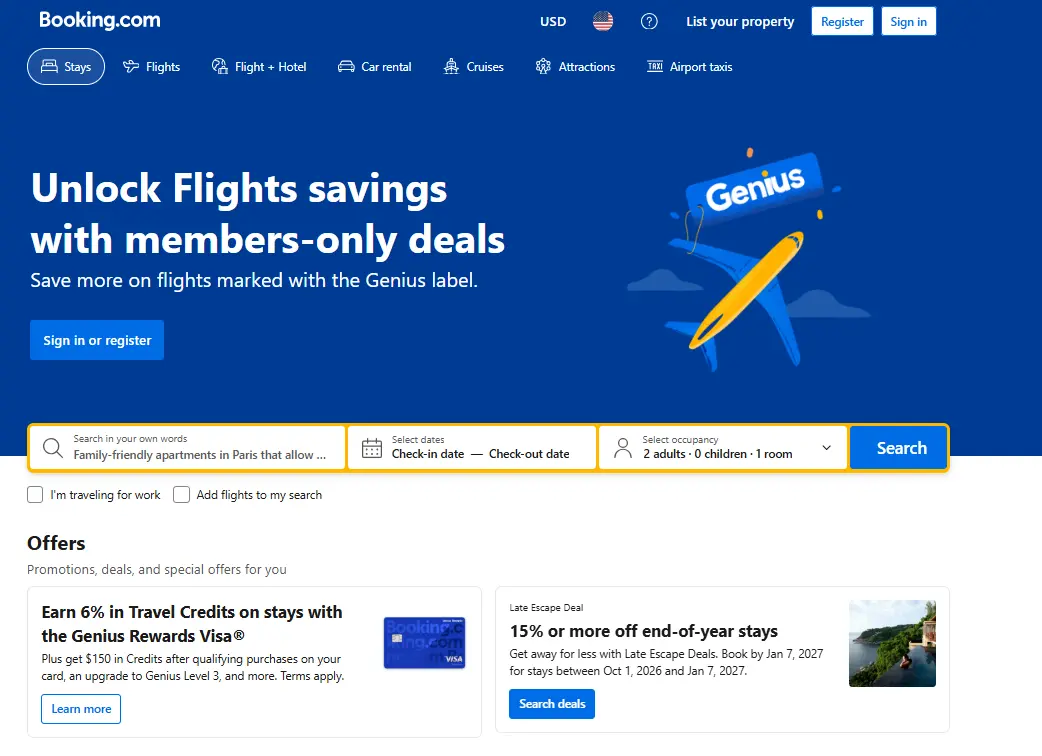
Booking.com’s biggest advantage is range. You can compare chains, independent hotels, resorts, hostels, apartments, and guesthouses in one search.
Its filters cover neighborhood, distance, review score, meal plan, accessibility, room type, and cancellation policy. The map helps you avoid a cheap room far from public transport or your preferred area.
Cancellation and payment rules are set for each rate, not for the platform as a whole. One room may be refundable until a stated date, while a cheaper room at the same hotel may become nonrefundable immediately. Read the exact rate conditions before paying.
Pros
Excellent choice in most international destinations
Strong filters and map search
Plenty of verified-stay reviews
Good selection of flexible rates
Cons
The large number of listings can feel overwhelming
Breakfast, city tax, or resort fees may not be included in every displayed price
Support outcomes can depend on both the platform and the property
Best for: Travelers who want the broadest selection and easy comparison across different accommodation types.
2. Agoda: Best for Hotels in Asia
Agoda is particularly useful for Thailand, Japan, Malaysia, Indonesia, Vietnam, Singapore, South Korea, and other Asian markets. It also lists hotels worldwide, but its regional depth is why many frequent Asia travelers keep it in their comparison routine.
The site regularly presents several rates for the same room. Differences may involve breakfast, cancellation, payment timing, or membership eligibility. A low rate can be genuinely good, but compare the checkout total carefully because tax presentation can depend on the destination and selected display settings.
Agoda’s promotions can make comparison less straightforward. Two travelers may see different prices based on device, account status, currency, or active offer. Treat the final checkout page as the real price.
Pros
Often competitive for Asian hotels
Good regional selection beyond major international chains
Frequent app and member offers
Useful for short city stays and beach destinations
Cons
Promotional labels can make rates harder to compare
Taxes and service charges need close checking
Some discounted bookings have strict cancellation terms
Best for: Travelers visiting Asia who are willing to inspect the final price and rate conditions closely.
3. Expedia: Best for Hotel and Flight Packages

Expedia keeps flights, hotels, transfers, car rentals, and activities under one account. Packages may save money, while a combined itinerary makes a multi-part trip easier to manage.
Hotel search includes familiar filters for guest rating, star class, neighborhood, amenities, meal plans, and payment options. Expedia also offers member prices on selected stays. Reward availability and program terms can differ by country, so check what applies to the account and market you use.
Packages require careful comparison. Check the same flight and hotel separately before booking. Also examine whether the package changes your cancellation rights, room conditions, baggage allowance, or flight flexibility.
Pros
Convenient for complete trip planning
Package rates can offer good value
Strong selection in popular global destinations
Useful app for itinerary management
Cons
Package changes can be more complicated than changing one booking
Standalone hotel rates may be beaten elsewhere
Rewards and benefits vary by region
Best for: Travelers booking an international flight and hotel together, especially for a straightforward holiday.
4. Hotels.com: Best for a Hotel-First Search
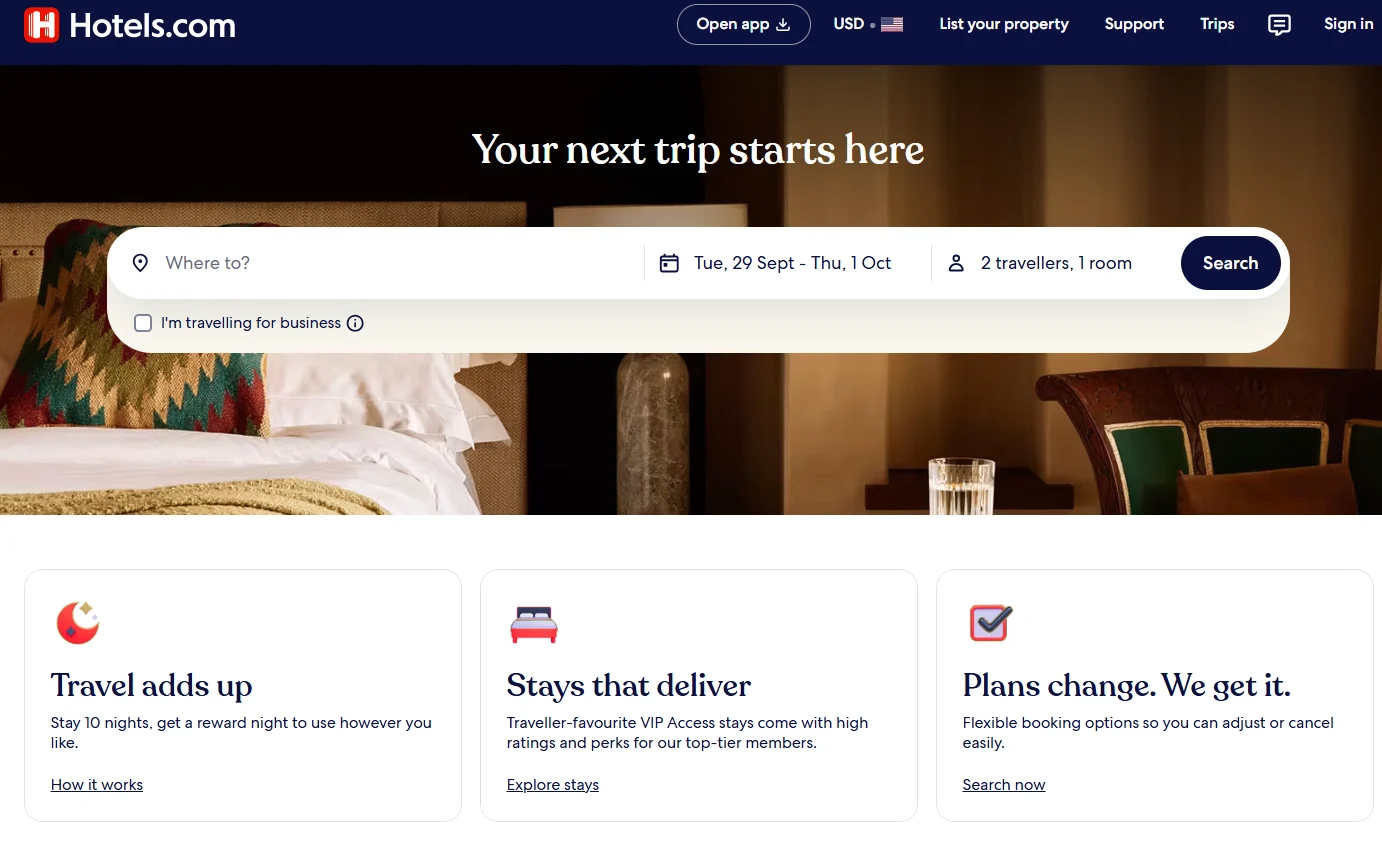
Hotels.com stays focused on accommodation, covering hotels, resorts, apartments, and vacation homes worldwide. Its uncluttered layout makes room comparison easy.
Its filters cover common international needs such as refundable rates, breakfast, airport transfers, family-friendly facilities, accessibility, and guest rating. The map is useful for comparing a property’s actual location with train stations, tourist areas, business districts, or beaches.
Hotels.com has used different reward structures in different countries, and programs can change. Sign in, set the correct country, and read the current terms rather than assuming a benefit seen in another market will apply to your booking.
Pros
Clean, easy-to-use hotel comparison process
Good range from budget stays to luxury resorts
Helpful map and neighborhood information
Member deals on eligible listings
Cons
Loyalty value differs by country and program
Prices may match sister platforms, limiting the benefit of repeated searches
Some local charges are payable directly to the property
Best for: Travelers who want a simple accommodation search and prefer to keep hotel bookings in one account.
5. Trip.com: Best for Asia-Pacific and Mobile Travelers

Trip.com is strong for China and the wider Asia-Pacific region. Combining hotels with flights and trains helps on multi-city trips, while its app suits travelers managing plans on the move.
The platform lists major hotel brands as well as regional properties that may not appear as prominently on Western booking sites. Member tiers, eligible discounts, and Trip Coins can add value for repeat users, but the cheapest rate still deserves a careful look at cancellation and payment rules.
For small or less-reviewed properties, check recent guest comments and the map pin carefully. Transliteration and translated property names can occasionally make an address harder to match across map services.
Pros
Particularly useful for multi-city Asian trips
Good app experience
Regional hotel selection beyond global chains
Integrated transport booking
Cons
Review volume may be limited for some small hotels
Benefits depend on tier and booking eligibility
Fare and hotel rules can vary across products in one itinerary
Best for: Mobile-first travelers planning an Asia-Pacific trip with hotels, trains, or flights.
How to Book an International Hotel Safely
1. Set the Correct Dates and Guest Details
Check the local arrival date, especially after an overnight flight or an International Date Line crossing. Enter every guest, including children, because occupancy rules and breakfast charges can change the price.
2. Search by Neighborhood, Not Just City
Research where you need to be, then use the map. A lower nightly price loses its value if you spend extra money and an hour each day commuting.
3. Compare Like-for-Like Rates
Match the room type, bed, meal plan, cancellation deadline, payment timing, and occupancy. A nonrefundable room without breakfast is not a fair comparison with a flexible rate that includes breakfast.
4. Check the Final Payable Total
Proceed far enough to see taxes, service charges, resort fees, cleaning fees, and charges collected at the property. Also note whether the card will be charged in your chosen currency or the hotel’s local currency.
5. Read Recent Reviews
Focus on reviews from the last six to twelve months. Search for repeated comments about noise, renovation, cleanliness, Wi-Fi, air-conditioning, neighborhood safety, and transport access.
6. Confirm the Cancellation Deadline
Deadlines usually follow the property’s local time. Save the exact date, time, penalty, and payment terms instead of relying only on a “free cancellation” badge.
7. Save and Reconfirm the Booking
Keep an offline copy of the confirmation, hotel address, and contact number. For an important stay, contact the hotel a few days before arrival to confirm the room, guest names, and any late check-in request.
Insider Tips for Getting a Better Hotel Deal
Compare the checkout total on at least two sites. Headline prices can exclude different fees.
Check the hotel’s own website. Direct rates may include breakfast, points, upgrades, or easier changes.
Search while signed in and signed out. Member rates help sometimes, but they are not automatically the cheapest.
Use a card with low or no foreign transaction fees. A good room deal can be weakened by bank charges.
Avoid automatic currency conversion without comparing it. Paying in local currency may offer a better card-network exchange rate, though your bank’s fees matter.
Take screenshots of the room and inclusions. This gives you useful evidence if the assigned room or meal plan differs.
Book a flexible rate early, then recheck. If the price falls before the deadline, you may be able to cancel and rebook.
Do not rely on star ratings alone. Classification systems differ between countries. Recent guest reviews and photos are often more useful.
Frequently Asked Questions
Which site is best for booking international hotels?
Booking.com is the strongest all-round choice because of its broad inventory, filters, map, and range of flexible rates. Agoda may be better in parts of Asia, while Expedia is useful for packages.
Is it cheaper to book directly with an international hotel?
Sometimes. A hotel may match the public rate and add breakfast, points, or flexible cancellation. Booking sites can still win through member prices or stronger regional inventory, so compare both totals.
Are international hotel booking sites safe?
Major platforms are generally safe to use, but scams can target travelers through messages or fake links. Use the official app or website, avoid moving payment to an unknown channel, and contact support if a message asks for unexpected card details.
Should I pay in my home currency or local currency?
Local currency is often better when your card has favorable exchange rates and no foreign transaction fee. Compare the offered conversion rate and your bank’s charges before choosing.
What does free cancellation really mean?
It means you can cancel without the stated room penalty only until the listed deadline. Currency differences, previously charged deposits, or bank processing times may still affect the refunded amount.
How can I avoid hidden hotel fees abroad?
Review the checkout breakdown and look for city taxes, resort fees, service charges, cleaning fees, deposits, and charges due at the property. Read the fine print beneath the total before confirming.
Is it safe to book a nonrefundable international hotel rate?
It is safe when your plans are firm and the savings justify the risk. For visa-dependent trips, uncertain flights, or long stays, a refundable rate is usually worth the extra cost.
Final Verdict
For most travelers, Booking.com is the best site for international hotels because it combines broad global coverage with strong filters, recent reviews, and plenty of flexible booking options. Agoda is the first alternative to check for Asia, while Expedia makes sense when a flight-and-hotel package offers real savings.
Choose Hotels.com for a simple hotel-focused experience and Trip.com for Asia-Pacific itineraries that also involve trains or flights. The winning site is the one that offers the right room, clear terms, and the lowest final price for your exact dates. Compare carefully, save the confirmation, and never let a flashy discount distract you from cancellation rules or fees.
Some links on this page are affiliate links. If you book through one we may earn a commission, at no extra cost to you. It never affects our ratings, our rankings, or the price you pay.