Expedia vs. Hotels.com
Expedia and Hotels.com are two of the most recognizable online travel agencies (OTAs), but they are designed around slightly different booking experiences.
Introduction
Expedia and Hotels.com are two of the most recognizable online travel agencies (OTAs), but they are designed around slightly different booking experiences. Both belong to Expedia Group, alongside brands such as Vrbo, and both participate in the company's broader One Key loyalty ecosystem.
The biggest distinction is positioning. Expedia is a broader, one-stop travel platform, covering hotels, vacation rentals, flights, car rentals, packages, activities and other trip components. Hotels.com is much more hotel-focused, putting accommodation discovery, hotel comparison and stay-related rewards at the center of the experience. Expedia itself describes its offering as a place to book flights, hotels, cars, packages and activities, while Expedia Group describes Hotels.com as a hotel-first brand.
TL;DR
There isn't a universal cheaper option. Prices can change by property, dates, room type, cancellation terms and member status.
Choose Expedia when you want to book an entire trip, particularly flights + hotels + cars.
Choose Hotels.com when the hotel is the main thing you're shopping for and you want a streamlined accommodation-focused experience.
Compare the final checkout price, rather than assuming either brand will always be cheaper.
For frequent travelers, One Key makes the distinction smaller because the same loyalty ecosystem spans Expedia and Hotels.com.
Inventory and Global Reach
Expedia Group has a very large accommodation network. Its Expedia TAAP business currently advertises access to more than 3 million properties, covering hotels, vacation rentals, all-inclusive resorts and more than 35 lodging categories.
That number should not be interpreted as “3 million unique hotels on Expedia and another 3 million unique hotels on Hotels.com.” The two consumer brands share Expedia Group's broader supply ecosystem, so there can be substantial overlap.
Expedia
Expedia's accommodation search includes traditional hotels as well as apartments, condos, villas, cottages, resorts, all-inclusive properties and other accommodation categories. Its broader ecosystem also connects travelers with vacation rentals through Expedia Group's other brands.
The advantage becomes particularly noticeable when a traveler is planning a complex itinerary. Instead of switching between hotel, flight and car websites, Expedia can keep those components inside one booking ecosystem.
Hotels.com
Hotels.com is deliberately more accommodation-centric. Its inventory includes hotels, resorts, motels, hostels, apartments and other lodging options. Its search tools also support filters for property class, traveler type, amenities and location.
Asia vs. Europe vs. North America
It is difficult to declare a permanent regional winner because availability and pricing are destination-specific. Both brands draw from Expedia Group's global supply network, and the same hotel can appear on both platforms.
For travelers in North America and Europe, both offer extensive hotel coverage. In Asia, availability can vary considerably by destination and property, so travelers should compare the specific city and dates rather than relying on a blanket assumption about regional dominance.
Inventory takeaway: Expedia has the broader overall travel ecosystem, while Hotels.com is more tightly focused on accommodation.
Pricing and Fee Transparency
This is where travelers should be especially careful.
The price you see while browsing is not necessarily the amount ultimately charged. Taxes, mandatory fees, resort fees, local charges, currency conversion and the selected payment/cancellation terms can affect the final cost.
Hotels.com promotes upfront pricing and hotel comparison tools, while individual hotel listings can display totals that include taxes and fees depending on the market and booking configuration.
Expedia similarly provides refundable filters and booking information, but travelers should still open the complete rate details before paying. Expedia states that eligible properties can be filtered for fully refundable options.
Display price vs. final price
Suppose two sites advertise a room at ₹5,000.
That does not automatically mean the bookings cost the same.
You should compare:
Room price
Taxes and mandatory fees
Resort or destination fees
Breakfast and other inclusions
Cancellation deadline
Pay-now vs. pay-at-property terms
Currency used for the transaction
Member discounts
Coupon or OneKeyCash redemption
Final amount shown immediately before payment
Price guarantees
Expedia has a price guarantee for qualifying hotel bookings. Its current terms require the competing price to match important details such as property, room type, dates, rate plan, refund/change policy and included extras. Claims generally need to be submitted before midnight local hotel time on the day of check-in. Membership-only rates, packages and certain other offers are excluded.
Hotels.com also offers a Price Guarantee. In India, for example, the policy says a qualifying lower price can result in a refund of the difference for refundable bookings; for non-refundable bookings, the difference may instead be issued as a future coupon. Claims can generally be submitted until the day before check-in, subject to the terms.
Pricing takeaway: Neither platform should be considered permanently cheaper. Compare the same room + same dates + same cancellation terms + final payable amount.
User Interface and Booking Experience
Expedia
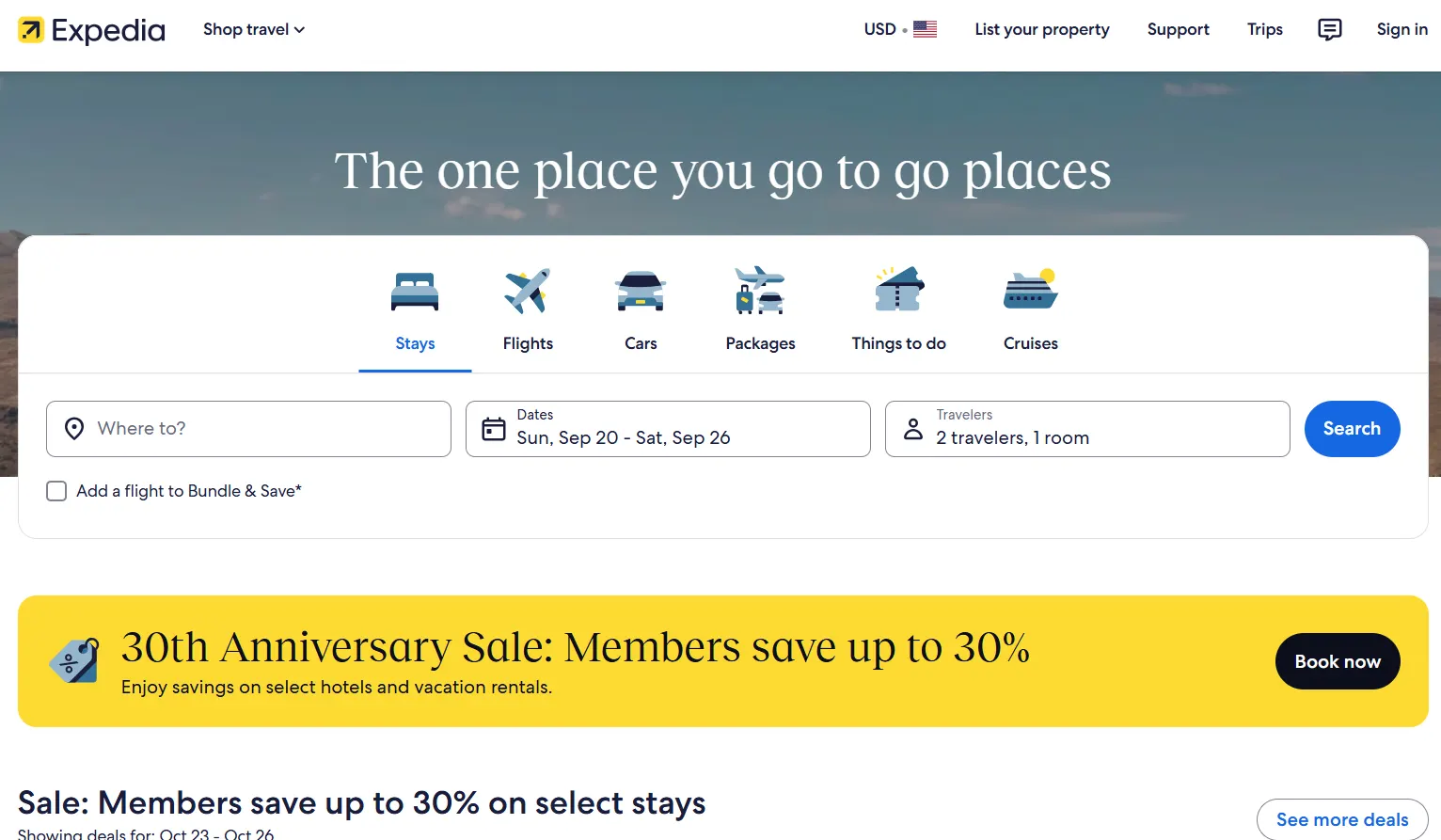
Expedia is designed around the entire journey. The homepage prominently supports stays, flights, cars, packages and activities, and travelers can combine components through package-style bookings.
Its hotel search includes substantial filtering, including property type, amenities, refundable rates and other characteristics. Expedia also promotes tools such as price tracking and booking management.
The trade-off is that the interface can feel more feature-heavy because Expedia is trying to serve travelers booking much more than accommodation.
Hotels.com
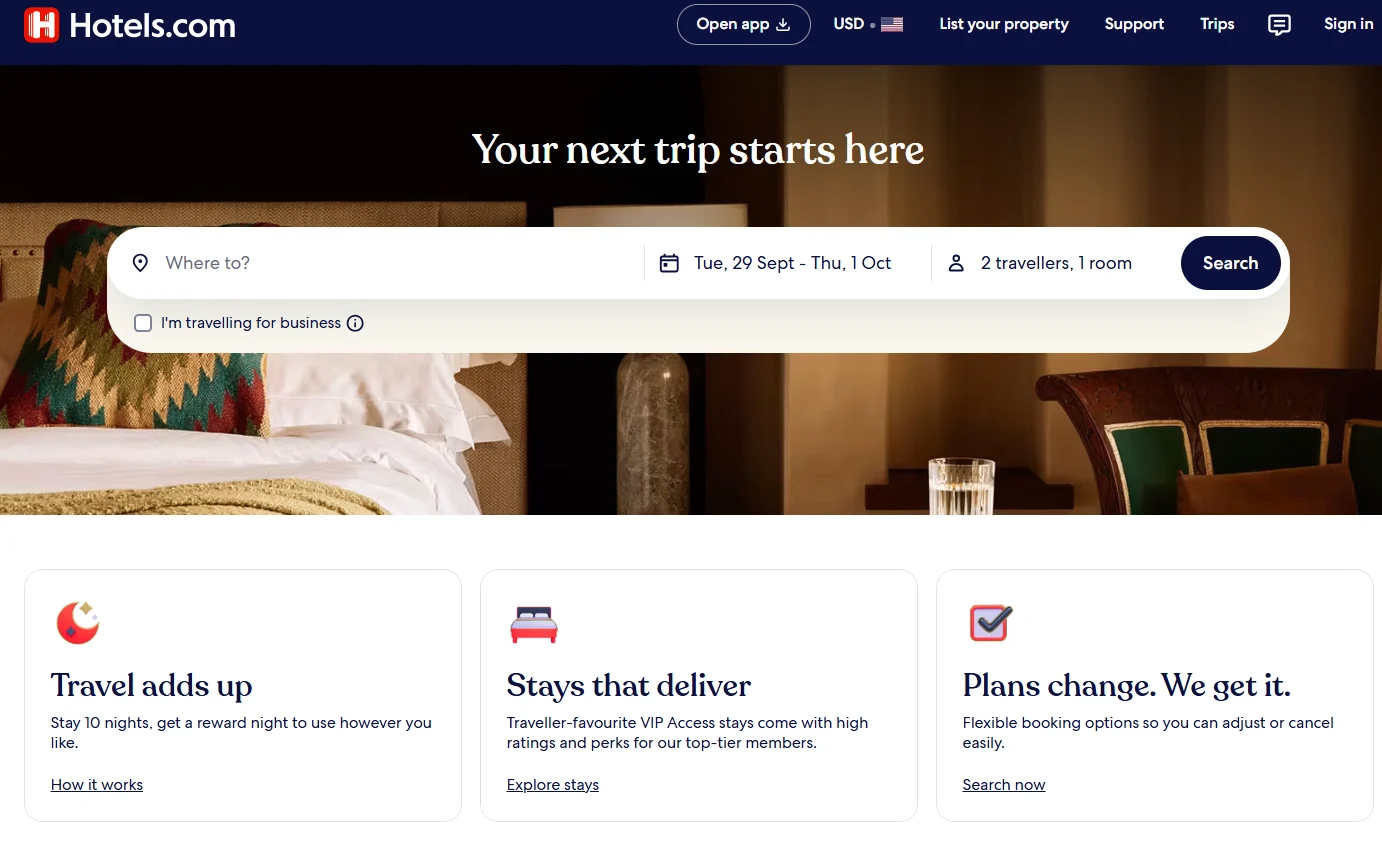
Hotels.com puts accommodation discovery first. Its interface emphasizes hotel photographs, reviews, location, amenities, room choices and price comparisons. Its interactive map is particularly useful when the exact neighborhood matters.
For someone who already has a flight booked and simply needs a hotel, this hotel-first approach can feel more straightforward.
Desktop vs. mobile
Both platforms provide mobile apps and web experiences, with booking management and customer-support tools available digitally. Expedia's broader product set makes its app useful for managing multiple parts of a trip, while Hotels.com's focused design can be more convenient for hotel-only shopping.
UX takeaway: Expedia is better suited to trip-wide planning; Hotels.com is naturally suited to hotel research.
Loyalty Programs: One Key vs. Hotels.com Rewards

This is the most important area to understand in 2026 because the loyalty landscape has changed.
Expedia: One Key
Expedia participates in One Key, a unified Expedia Group loyalty program. In India, the current program has four levels:
Trip Elements can come from eligible hotel nights, vacation-rental nights, flights, car-hire days and certain other eligible travel components.
In India, Expedia currently advertises:
Blue: 10%+ Member Prices on more than 100,000 hotels
Silver: 15%+ savings on more than 10,000 hotels
Gold: 20%+ savings on more than 10,000 hotels
Platinum: 20%+ savings on more than 10,000 hotels
Silver, Gold and Platinum members can also receive progressively stronger OneKeyCash opportunities and additional VIP Access benefits. Gold and Platinum members may receive room upgrades when available at participating VIP Access properties.
The important advantage is that the loyalty system can reward different components of a trip, rather than requiring every booking to be a hotel.
Hotels.com
Hotels.com has historically had a hotel-focused rewards structure based on Stamps, but its current terms are transitioning users into the broader One Key ecosystem. The terms still document Hotels.com Rewards tiers of Rewards, Silver and Gold, with Silver beginning at 10–29 Stamps and Gold at 30+ Stamps during a membership year.
At the same time, Hotels.com now promotes OneKeyCash and One Key member discounts. Hotels.com says OneKeyCash can be used on eligible hotel bookings, while members can receive discounts and other benefits.
This means travelers should check the specific Hotels.com market and account interface they're using because loyalty mechanics can vary during the transition.
Which loyalty model suits which traveler?
For someone taking mixed trips involving hotels, flights and cars, One Key's cross-trip structure is particularly relevant.
For a traveler who mostly cares about hotel stays, Hotels.com's accommodation-first rewards experience remains compelling, especially for people who have an existing Hotels.com account with qualifying rewards activity.
Loyalty takeaway: The gap between Expedia and Hotels.com has narrowed substantially because both are tied into One Key.
Cancellation and Refund Policies
Neither Expedia nor Hotels.com has one universal cancellation policy for every hotel.
The hotel's individual rate rules control the booking. One room may be refundable until 24 or 48 hours before arrival, while another rate at the same property may be completely non-refundable.
Expedia displays qualifying fully refundable properties and offers a refundable filter, making it easier to narrow the search.
Hotels.com similarly highlights free cancellation on many properties.
Who handles the cancellation?
The OTA normally manages the reservation interface, payment or communication process depending on the rate, but the underlying cancellation and refund obligations can depend on the travel supplier.
This distinction becomes important with problems such as:
Hotel overbooking
Property closure
Incorrect room type
Failed check-in
Refund delays
Changes requested after the cancellation deadline
Both Expedia and Hotels.com provide online customer-service portals and 24/7 support. Expedia Group says its customer-care teams can assist during major travel disruptions, while Hotels.com advertises 24/7 support before and during stays.
Practical advice: Before paying, screenshot or save the cancellation deadline and exact refund conditions.
Bundling and Extra Services

This is one category where Expedia has a clear structural advantage.
Expedia directly supports:
Hotels
Flights
Car rentals
Vacation rentals
Packages
Activities
Ground transportation and other travel components
Its website specifically promotes adding flights to hotel bookings and package savings, although Expedia notes that savings vary and aren't available on every package.
Expedia is therefore designed for the traveler who wants to create a complete itinerary in one ecosystem.
Hotels.com is much more specialized around accommodation. It can be the simpler choice when the flight and transportation have already been arranged elsewhere.
For example, a traveler flying from Delhi to Bangkok, renting a car and booking several hotels might prefer Expedia's broader ecosystem. Someone who has already purchased their flights and simply wants to compare Bangkok hotels may find Hotels.com's focused approach more relevant.
Bundling takeaway: Expedia is the more comprehensive one-stop-shop platform.
Customer Support and Trust
Customer reviews should be treated as a signal rather than a definitive measurement of booking quality. OTA review platforms often attract customers who had unusually good or bad experiences.
As of September 2026, Trustpilot displayed a 1.5/5 TrustScore for Expedia from roughly 12,600 reviews and 1.2/5 for Hotels.com from roughly 12,200 reviews. These scores reflect the experiences and reviewing behavior of Trustpilot users, not every Expedia or Hotels.com customer.
Recent reviews for both companies include complaints concerning refunds, customer service and booking problems, while both pages also contain positive experiences.
This is particularly relevant to OTA bookings because the OTA sits between the traveler and the hotel. When something goes wrong, the traveler may need coordination between both parties.
Neither platform should therefore be treated as a guarantee against hotel overbooking, inaccurate property information or refund delays. Checking the hotel's own cancellation terms and keeping booking documentation remains important.
Expedia: Pros and Cons
Pros
Broad travel ecosystem beyond hotels
Flights, hotels, cars, packages and activities in one platform
One Key rewards can span different trip components
Strong filtering and search tools
Fully refundable hotel filter
Price guarantee for qualifying bookings
24/7 customer support
Large global accommodation supply
Useful for complex itineraries
Cons
Interface can feel more complicated for hotel-only shoppers
Final prices can vary depending on taxes, fees and rate conditions
Refunds can involve coordination between Expedia and the supplier
Price guarantees have significant eligibility conditions
Trustpilot currently shows substantial negative customer feedback
Hotels.com: Pros and Cons
Pros
Strong hotel-first booking experience
Useful map and accommodation filters
Large worldwide hotel inventory
Member discounts through One Key
Price Guarantee available for qualifying bookings
Many properties offer flexible cancellation
24/7 customer support
Particularly convenient for hotel-only travelers
Existing Hotels.com Rewards users may have legacy benefits during the loyalty transition
Cons
Less focused on complete-trip planning than Expedia
Flights and car rentals are not its core proposition
Loyalty structure has become more complicated because of the transition toward One Key
Refund and support experiences can vary when the hotel itself must resolve an issue
Trustpilot currently shows substantial negative customer feedback
Final Verdict: Who Should Use Expedia vs. Hotels.com?
The most useful way to choose between Expedia and Hotels.com is to match the platform to the type of trip you're booking.
Budget travelers
Compare both sites for the exact same room and dates. Don't assume one is always cheaper. Pay particular attention to member prices, taxes, mandatory fees and cancellation conditions.
Luxury travelers
Expedia can be useful when VIP Access properties and One Key benefits are relevant. Gold and Platinum members may receive additional VIP Access perks such as upgrades when available.
Business travelers
Expedia's broader ecosystem can be useful for travelers who need flights, hotels and cars together. Hotels.com can make sense when accommodation is the only booking requirement.
Solo travelers
Either platform can work well. Hotels.com is particularly suitable when the trip is mainly about finding a hotel, while Expedia becomes more useful if the traveler wants to organize multiple components.
Families and multi-city travelers
Expedia's broader package and trip-planning capabilities can be useful when several components need to be coordinated.
Some links on this page are affiliate links. If you book through one we may earn a commission, at no extra cost to you. It never affects our ratings, our rankings, or the price you pay.