Bangkok Airways Baggage Allowance
The Bangkok Airways baggage allowance is relatively simple, but a few details can cause problems at the airport.
The Bangkok Airways baggage allowance is relatively simple, but a few details can cause problems at the airport. Economy passengers normally receive 20 kg of checked baggage, while Blue Ribbon Class passengers receive 40 kg. Cabin baggage is controlled by both weight and aircraft-specific size limits.
The most important detail is that Bangkok Airways operates smaller ATR aircraft alongside Airbus jets. A suitcase that fits comfortably in an Airbus overhead compartment may be too large for an ATR cabin. Your route, operating aircraft, passenger type, and loyalty status can therefore affect how you should pack.
This guide explains checked baggage, hand luggage, excess charges, sports equipment, infant allowances, restricted items, and what to do when your suitcase is delayed or damaged.
Bangkok Airways Baggage Allowance at a Glance
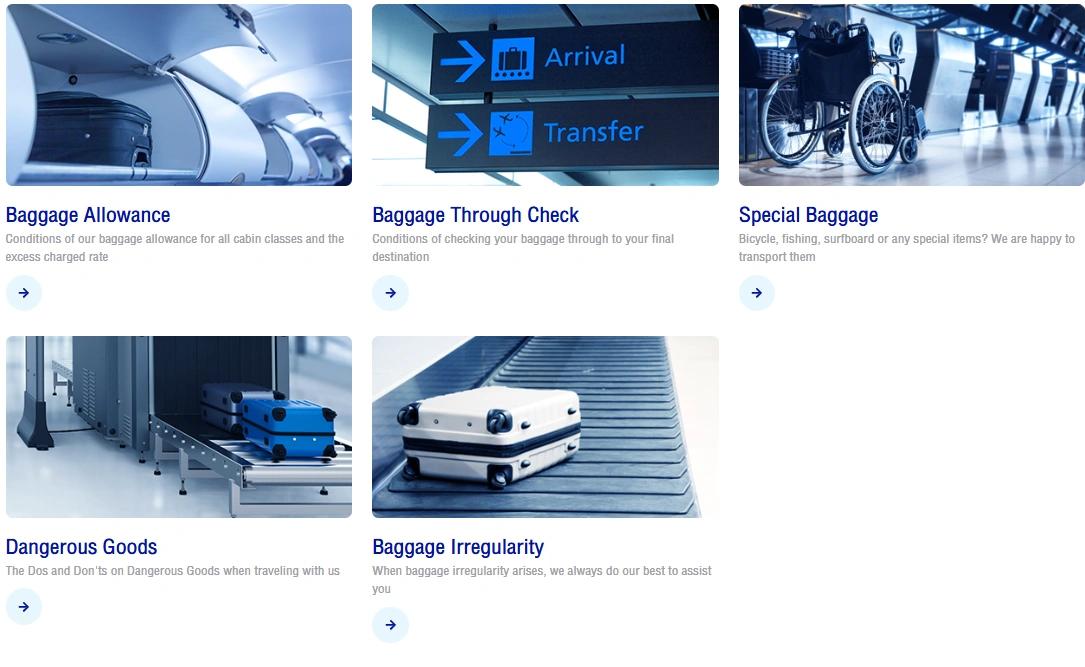
Bangkok Airways mainly uses the weight concept for checked luggage. This means your allowance is based on the combined weight of your checked bags rather than a fixed number of pieces.
| Passenger or cabin | Checked baggage allowance | Cabin baggage | Main condition |
|---|---|---|---|
| Economy Class adult or child | 20 kg | One cabin bag | Must meet aircraft size and weight limits |
| Blue Ribbon Class adult or child | 40 kg | One cabin bag | Available only on eligible services |
| Infant without a seat | 10 kg | No standard cabin bag | Infant equipment may have separate handling rules |
| Infant with a purchased seat | Based on booked fare | One cabin bag | Child restraint rules may apply |
| Codeshare passenger | Depends on operating airline | Depends on operating airline | Check the carrier operating each flight |
The allowance shown on your e-ticket or booking confirmation takes priority. Promotional fares, connecting itineraries, codeshare flights, and tickets issued by partner airlines may follow different conditions.
Bangkok Airways Checked Baggage Allowance
Economy Class
Adults and children traveling in Economy Class generally receive 20 kg of free checked baggage. The allowance applies to the total weight of the bags checked under one passenger’s name.
For example, you could check:
One suitcase weighing 20 kg
Two suitcases weighing 10 kg each
One 15 kg suitcase and another 5 kg bag
The total must remain within 20 kg. Airport staff may also apply limits to the number, size, or condition of bags if they cannot be handled safely.
Blue Ribbon Class
Blue Ribbon Class is Bangkok Airways’ premium cabin on selected services. Adults and children booked in this class normally receive 40 kg of checked baggage.
That allowance is helpful for longer holidays or trips involving diving, golf, or other equipment. However, the individual-bag safety limit still applies. A 40 kg allowance does not mean you can pack all 40 kg into one suitcase.
Maximum Weight Per Bag
A single checked bag must not weigh more than 32 kg. This is an airport handling and workplace safety restriction.
If one suitcase weighs 35 kg, Bangkok Airways may ask you to divide the contents between two bags, even if your total allowance covers the weight. Carry a foldable spare bag when traveling with heavy equipment or large purchases.
Combining Allowances
Passengers traveling together should not automatically assume that their allowances can be pooled. Airport staff may allow baggage to be processed together when passengers are on the same reservation and checking in at the same time, but this should not be treated as guaranteed.
The safest approach is to keep each passenger’s luggage within their individual allowance. This is especially important when travelers have separate booking references.
Bangkok Airways Carry-On Baggage Allowance
Passengers are generally allowed one main piece of cabin baggage. It must be light enough for safe storage and small enough to fit in the aircraft’s overhead compartment or beneath the seat.
Bangkok Airways has used a cabin-bag weight limit of up to 7 kg, but travelers should check the allowance printed on their booking because older tickets and certain operational conditions may show a more restrictive limit.
Carry-On Size by Aircraft
| Aircraft type | Maximum cabin-bag dimensions | Practical advice |
|---|---|---|
| ATR 72 | 50 × 36 × 23 cm | Use a compact soft-sided bag |
| Airbus A319 or A320 | 56 × 36 × 23 cm | A standard small cabin suitcase may fit |
| Unconfirmed aircraft | Follow the smaller ATR limit | Reduces the risk of gate-checking |
Measurements include wheels, handles, side pockets, and external frames. A hard-shell case measuring exactly 56 cm may be suitable for an Airbus flight but too long for an ATR service.
Aircraft assignments can also change for operational reasons. If you want one bag that works across most Bangkok Airways flights, pack according to the 50 × 36 × 23 cm ATR limit.
Can You Take a Personal Item?
A small handbag, camera bag, laptop case, or similar personal item may be accepted if it can be placed safely under the seat and does not create a storage problem. The cabin crew has the final say.
Do not assume that a large backpack counts as a free personal item in addition to a full-size cabin case. On busy ATR flights, cabin storage is limited, and larger items may need to be checked at the gate.
Infant and Child Baggage Rules
A child traveling in a purchased seat normally receives the baggage allowance attached to the fare. In Economy Class, that is commonly 20 kg of checked baggage.
An infant traveling without a separate seat normally receives 10 kg of checked baggage. However, the infant may not receive the same cabin-bag allowance as an adult or seated child.
Parents should confirm how the airline will handle:
A folding stroller
A child car seat
A portable cot
A baby carrier
Formula, milk, and baby food
A diaper bag
Strollers may be accepted at check-in or taken to the aircraft door, depending on the airport and local procedures. Attach your contact details and remove loose accessories before handing over the stroller.
How to Buy Extra Baggage
Buying additional baggage before departure is usually easier and may cost less than paying the standard excess charge at the airport.
Step 1: Check Your Included Allowance
Open your booking confirmation and look for the baggage field. Confirm the allowance for every flight, especially if your trip includes another airline.
Step 2: Weigh Everything at Home
Use a luggage scale after completing your packing. Weigh cabin baggage separately because moving items into your hand luggage may not work if that bag is already at its limit.
Step 3: Open Manage My Booking
Visit the Bangkok Airways website and access Manage My Booking using your reservation information. Look for an option to purchase prepaid baggage.
Online purchases generally need to be completed at least two hours before departure. Availability and deadlines can change, so buying earlier is sensible.
Step 4: Use an Alternative Sales Channel
If the online option is unavailable, contact:
Bangkok Airways’ call center
A Bangkok Airways ticket office
The travel agent that issued your booking
Purchases through these channels generally need to be completed at least four hours before departure.
Step 5: Save the Confirmation
Keep the receipt or updated booking confirmation on your phone. Check that the extra allowance appears correctly against the right passenger and flight.
Prepaid baggage normally applies only to Bangkok Airways-operated flights. It is also generally non-refundable and non-reroutable, so verify your plans before buying it.
Excess Baggage Charges
If your checked luggage exceeds the included allowance, Bangkok Airways may charge for each additional kilogram. The rate depends on the route or travel zone.
International destinations are divided into geographical zones. In general, longer routes attract a higher per-kilogram charge.
| Situation | Likely treatment |
|---|---|
| Bag is within free allowance | No standard checked-bag fee |
| Total weight exceeds allowance | Charge based on extra kilograms |
| Prepaid baggage purchased | Added to the original allowance |
| One bag weighs more than 32 kg | Passenger must repack it |
| Flight operated by another airline | Operating carrier’s charges may apply |
| Sports gear pushes total over allowance | Excess baggage charge applies |
Because charges and currency conversions can change, check the current amount during booking or in Manage My Booking. Airport excess-baggage payments are generally non-refundable.
Sports Equipment

Bangkok Airways accepts many types of sports equipment as checked baggage. The equipment is generally counted as part of your normal checked-baggage allowance rather than receiving a completely separate free allowance.
Common items may include:
Golf clubs
Bicycles
Surfboards
Diving equipment
Fishing equipment
Archery equipment
Skis or snowboards
If your Economy allowance is 20 kg and your suitcase weighs 14 kg, only 6 kg remains for sports equipment. Any weight above the combined allowance may be charged at the applicable excess-baggage rate.
Use a strong protective case and contact the airline before traveling with large equipment. Aircraft size matters, particularly on ATR-operated island routes where cargo space may be limited.
Remove compressed gas cylinders from diving equipment unless the airline has specifically confirmed they are acceptable. Bicycle tires may need to be deflated, handlebars turned, pedals removed, and the frame properly packed.
Liquids in Cabin Baggage
For international departures, liquids, aerosols, and gels in cabin baggage normally follow standard security rules:
Each container must hold no more than 100 ml
Containers should fit inside one transparent, resealable bag
The bag should generally have a capacity of no more than one liter
Each passenger is normally limited to one liquids bag
Larger containers may be rejected even when partly empty
Medicines, baby milk, and special dietary liquids may be exempt, but airport security may request supporting documents or additional screening.
Rules can differ on domestic Thai flights and at individual airports. Packing all non-essential liquids in checked luggage is the simplest option.
Batteries, Power Banks and Smart Luggage
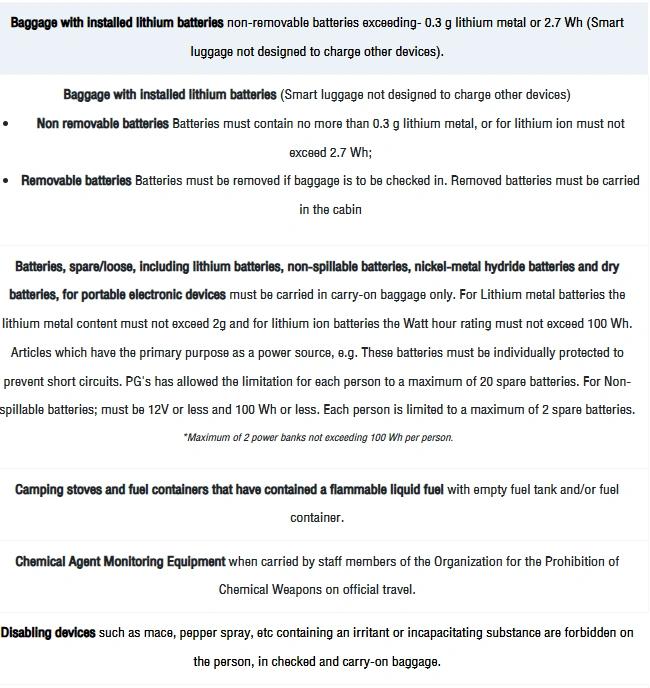
Power banks and spare lithium batteries must be carried in the cabin, not placed in checked baggage. Terminals should be protected against short circuits.
Bangkok Airways’ published dangerous-goods information states that power banks must have a clearly marked capacity. Power banks without an identifiable watt-hour rating may be refused.
Key rules include:
Power banks up to 100 Wh may be carried in the cabin, subject to quantity limits
Bangkok Airways limits passengers to two power banks
Power banks exceeding 100 Wh are not accepted under the airline’s stated policy
Spare batteries must be protected individually
E-cigarettes belong in cabin baggage and must be secured against activation
Devices packed in checked baggage must be fully switched off
For smart luggage, the battery must usually be removable. If the bag is checked, remove the battery and carry it in the cabin. A smart bag with a non-removable battery may be refused.
Prohibited and Restricted Items
Never pack dangerous items without checking the airline’s rules. Security staff or Bangkok Airways may refuse baggage containing unsafe articles.
Commonly prohibited or controlled items include:
Explosives and fireworks
Flammable fuel and lighter refills
Pepper spray and incapacitating devices
Tasers and electroshock weapons
Corrosive or toxic chemicals
Unapproved gas cylinders
Damaged or recalled lithium batteries
Weapons not declared and packed correctly
Knives, swords, and similar objects are not allowed in cabin baggage. Certain sporting firearms and ammunition may be accepted as checked baggage only with advance approval, legal documentation, safe packing, and compliance with destination laws.
Do not place cash, passports, jewelry, business documents, medication, computers, or other valuables in checked luggage. Keep them with you whenever security rules permit.
Codeshare and Connecting Flights
A Bangkok Airways flight number does not always mean Bangkok Airways operates the aircraft. A codeshare ticket may include services operated by another carrier with different baggage limits.
Before packing, check the words “operated by” beside every flight. When several airlines appear on one ticket, baggage rules may depend on the operating carrier, ticket structure, applicable regulations, and most significant carrier.
Also confirm whether your checked bags will be tagged to the final destination. Separate tickets may require you to collect your luggage, pass through customs, and check it in again.
Delayed, Damaged or Missing Baggage
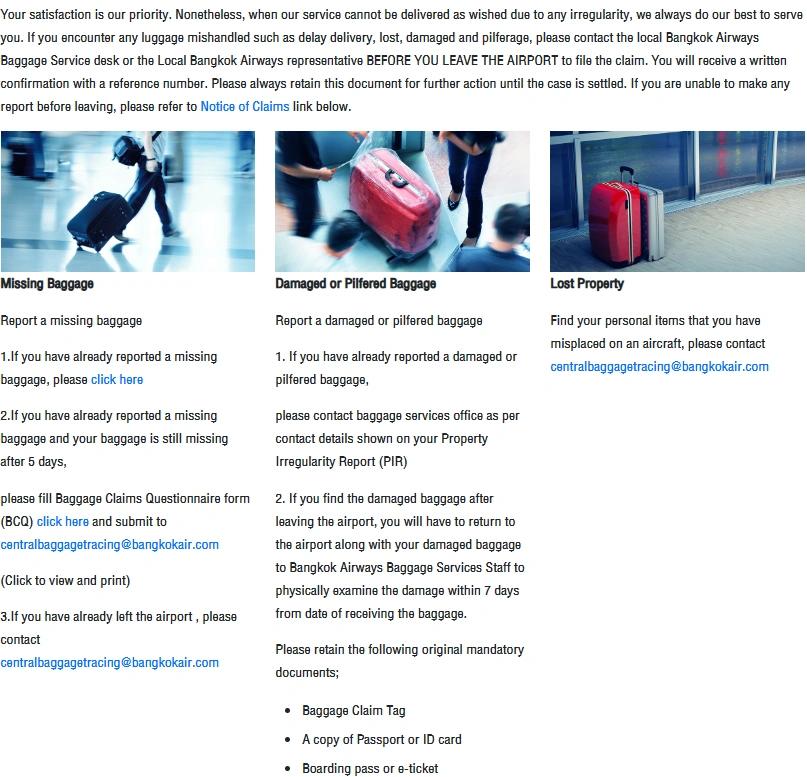
If your bag does not appear on the carousel, report it before leaving the baggage-claim area. Find the Bangkok Airways baggage desk or the airline’s ground-handling representative.
Be ready to provide:
Your boarding pass
The checked-baggage receipt
A description or photograph of the bag
Your local address
A working phone number
Details of any distinguishing features
For visible damage, report the problem immediately and photograph the suitcase from several angles. Keep receipts for essential replacement purchases if your baggage is delayed, but buy only reasonable necessities.
Damage caused by normal wear, weak packing, overfilled bags, or existing defects may not qualify for compensation. Claims are also subject to strict time limits.
Practical Packing Tips
A little preparation can prevent most baggage problems.
Pack for the aircraft: Follow ATR dimensions if your itinerary includes a regional or island route.
Leave a weight buffer: Aim to stay at least 1 kg below your allowance.
Photograph your luggage: Take pictures of the bag and its contents before check-in.
Use identification inside and outside: Add your name, phone number, and email address.
Remove old tags: They can interfere with automated sorting.
Carry essential medication with you: Pack enough for possible delays.
Split important items: Couples should place some clothing in each other’s bags.
Buy extra baggage early: Do not wait until the airport if you already know you are overweight.
Keep battery ratings visible: Security staff must be able to verify the capacity.
Pros and Cons of Bangkok Airways Baggage Policy
Pros
Economy tickets usually include 20 kg of checked baggage
Blue Ribbon Class provides a generous 40 kg allowance
Infants without seats receive a checked-baggage allowance
Sports equipment can count toward the normal allowance
Prepaid baggage is available before departure
The weight system gives passengers flexibility to use more than one bag
Cons
Cabin-bag dimensions depend on the aircraft
ATR flights have limited overhead storage
Prepaid baggage is generally non-refundable
Sports equipment does not automatically receive a separate free allowance
Codeshare itineraries can have different rules
A bag exceeding 32 kg must be repacked even when the total allowance is sufficient
Frequently Asked Questions
How much checked baggage does Bangkok Airways allow?
Economy Class adults and children normally receive 20 kg, while Blue Ribbon Class adults and children receive 40 kg. Infants without a separate seat generally receive 10 kg.
What is the Bangkok Airways hand-luggage limit?
Passengers can generally bring one cabin bag weighing up to 7 kg, subject to the allowance shown on their ticket. Maximum dimensions are commonly 50 × 36 × 23 cm on ATR aircraft and 56 × 36 × 23 cm on Airbus A319 and A320 aircraft.
Can I take two checked bags in Economy?
Yes, the airline primarily uses a total-weight system. Two bags may be accepted if their combined weight remains within your 20 kg allowance and each bag satisfies handling requirements.
What happens if my suitcase weighs more than 20 kg?
Economy passengers must pay for weight above the included allowance unless they have purchased additional baggage or receive an applicable loyalty benefit. Buying prepaid baggage before departure may offer better value.
Can one checked suitcase weigh 40 kg in Blue Ribbon Class?
No. A single checked bag cannot exceed 32 kg. Split the contents between two or more suitable bags.
Does Bangkok Airways allow power banks?
Yes, approved power banks can be carried in cabin baggage, but not in checked luggage. The capacity must be clearly marked, and Bangkok Airways limits passengers to two qualifying power banks under its current policy.
Is a stroller included for an infant?
Strollers are commonly accepted, but handling depends on the airport, aircraft, and booking. Contact Bangkok Airways before departure to confirm whether your stroller can be checked without affecting the infant’s allowance.
Does sports equipment have a separate allowance?
Usually not. Accepted sports equipment counts toward the passenger’s standard checked-baggage allowance. Excess weight is charged at the applicable rate.
Final Verdict
The Bangkok Airways baggage allowance is practical for a regional airline. A standard Economy ticket normally includes 20 kg of checked luggage, while Blue Ribbon Class doubles that allowance to 40 kg.
The main issue is cabin-bag size. Pack according to the smaller ATR limit when your aircraft is unknown, keep every checked piece below 32 kg, and purchase extra baggage before departure if needed. Finally, check your ticket rather than relying only on general rules, especially when another airline operates part of the journey.
Some links on this page are affiliate links. If you book through one we may earn a commission, at no extra cost to you. It never affects our ratings, our rankings, or the price you pay.