Can You Use Someone Else’s Credit Card to Book a Hotel?
Can you use someone else’s credit card to book a hotel? Yes, often, provided you have the cardholder’s permission and the hotel accepts the arrangement.
Can you use someone else’s credit card to book a hotel? Yes, often, provided you have the cardholder’s permission and the hotel accepts the arrangement. However, using a card to reserve a room does not automatically mean the hotel will accept that card for payment when its owner is absent.
This distinction matters when a parent pays for your trip, your partner books a weekend away, or an employer covers accommodation. A reservation can look confirmed online while the front desk still needs payment authorization before handing over the keys.
The safest approach is to check the property’s rules before booking, put the actual traveler’s name on the reservation, and arrange any required authorization in advance. Here is how to handle the process without an awkward surprise at check in.
Can You Book a Hotel With Someone Else’s Credit Card?

Many hotels and booking platforms allow reservations using another person’s credit card, but cardholder permission and hotel approval are separate requirements.
Booking.com, for example, says guests can book using someone else’s card with permission. It advises explaining the arrangement in the special requests field and notes that the property may require authorization from the cardholder.
Other hotel policies are more restrictive. Hilton’s published payment guidance distinguishes between a card used to guarantee a reservation and the payment card, which it says must match the reservation name.
Therefore, an online booking system accepting the card details is only the first step. You still need to establish whether the card can cover the stay and whether the guest must provide another payment method on arrival.
Does the Cardholder Have to Stay at the Hotel?
Not always. Some properties have a formal process allowing an absent cardholder to pay for another guest.
Marriott’s guidance describes a credit card authorization process for covering another person’s room, taxes, and potentially incidental charges. It also states that not all hotels accept these authorizations.
An approved arrangement may let the cardholder remain at home while the traveler checks in. Without approval, the property may require the cardholder’s presence or payment from the guest.
Understand the Three Different Payment Stages
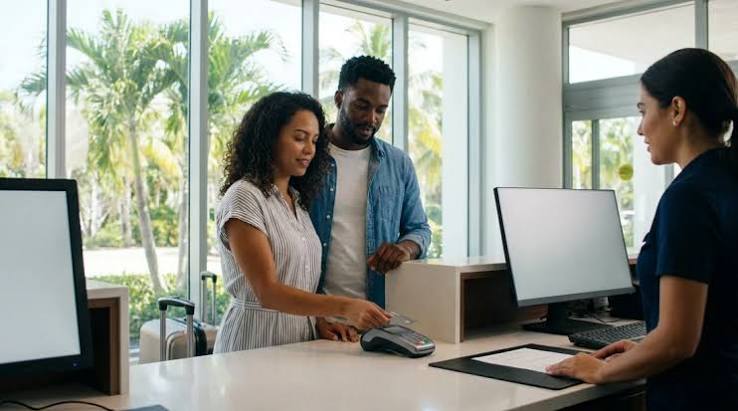
Much of the confusion comes from treating a reservation guarantee, room payment, and security deposit as the same thing.
1. The Reservation Guarantee
A guarantee card secures the booking according to the reservation terms. Depending on the rate, it may also be used for a deposit, late cancellation charge, or no show penalty.
A guaranteed reservation is not necessarily a paid reservation. Check the confirmation for wording such as “pay at property,” “deposit required,” or “payment collected before arrival.”
2. Payment for the Room
Payment covers the accommodation and whatever taxes or fees are included in the transaction. It may happen during booking, before arrival, at check in, or at checkout.
The key question is who collects it: the booking platform or the hotel. If the hotel handles payment, its rules for an absent cardholder remain particularly important.
3. The Incidental Deposit
A hotel may also request a deposit or card hold for extras, such as dining, parking, or other eligible charges.
Even when someone else has paid for the room, the guest may need an acceptable card for this deposit. Ask whether the authorization covers incidentals or only accommodation.
Common Booking Situations Compared
| Booking situation | Can it work? | What to confirm |
|---|---|---|
| Parent pays for an adult child | Often, with property approval | Authorization requirements and the guest’s deposit |
| Partner pays but will not travel | Property dependent | Whether an absent cardholder is accepted |
| Cardholder travels with the guest | Often simpler | Whether the cardholder must attend check in |
| Employer pays for a business trip | Often through an approved arrangement | Which charges the company covers |
| Booking platform collects payment | May be possible | Guest details and separate hotel deposit requirements |
| Someone else’s card guarantees a pay at property booking | May be possible | Who must pay on arrival |
| Hotel requires the cardholder’s presence | An absent cardholder arrangement may fail | An alternative approved payment method |
None of these situations creates an automatic exception to the hotel’s policy. A family relationship or company card does not replace whatever verification the property requires.
What Is a Hotel Credit Card Authorization Form?

A hotel credit card authorization form records the cardholder’s consent to pay specified charges for a named guest.
The process may use a secure online portal rather than a printable document. Typically, the hotel needs the reservation details, cardholder information, stay dates, and an explanation of which charges are authorized.
The coverage can be limited to:
Room charges and taxes
Particular extras, such as parking or breakfast
All permitted charges, subject to any agreed limit
Choose the coverage carefully. Paying for accommodation does not necessarily mean agreeing to cover every restaurant bill or room service order.
For example, a parent might authorize the room and taxes while asking their adult child to pay for extras. The hotel needs that distinction clearly recorded before arrival.
How Early Should You Submit It?
Ask the property for its deadline and allow time for review. Sending a form shortly before arrival leaves little room to fix missing information or a declined payment.
Marriott states that processing times follow local hotel procedures rather than one companywide standard. Submission alone should therefore not be treated as confirmation that everything is approved.
How to Book a Hotel Using Someone Else’s Credit Card

Step 1: Get Clear Permission From the Cardholder
Agree on the stay dates, expected cost, and charges the cardholder will cover.
Also discuss cancellation penalties. Someone offering to pay for a room should understand whether their card could be charged if the traveler cancels late or does not arrive.
Step 2: Contact the Specific Hotel
Speak with the property’s front desk or reservations team before choosing a restrictive rate.
Explain that the traveler and cardholder are different people, then ask:
Do you accept payment from an absent cardholder?
Is a credit card authorization required?
Which charges can it cover?
Does the guest need a separate card for incidentals?
What is the approval deadline?
Record the answers and request written confirmation of the arrangement.
Step 3: Put the Traveler’s Name on the Reservation
Enter the actual guest’s name as it appears on their identification. Use the cardholder’s details in the payment fields where requested.
Do not put the reservation solely in the payer’s name if that person will not be staying. Marriott’s booking guidance specifically directs customers booking paid stays for someone else to enter the guest’s information and arrange payment with the property.
Step 4: Read the Payment and Cancellation Terms
Check whether the rate is prepaid, refundable, or payable at the hotel.
Look for requirements involving the original payment card, cardholder identification, and deposits. If a condition conflicts with your arrangement, resolve it before committing to the booking.
Step 5: Complete the Hotel’s Official Authorization Process
Ask the property to provide its current form or secure payment link.
The cardholder should complete their own authorization and any required verification. A generic form downloaded elsewhere may not satisfy the hotel’s procedures.
Step 6: Confirm Approval Before Traveling
Ask the hotel to confirm that authorization has been received, accepted, and attached to the correct reservation.
Confirm exactly what remains payable by the guest. Keep the response with the booking confirmation so the traveler can explain the arrangement clearly.
Step 7: Prepare for Check In
The guest should bring their identification, reservation details, and any payment method the hotel requires.
Keep the cardholder reachable around arrival time in case clarification is needed. This is useful backup, but a phone call may not replace the hotel’s formal authorization process.
Can You Use Someone Else’s Card Through a Booking Website?
Sometimes, but the booking website’s acceptance rules and the hotel’s arrival requirements can differ.
If a platform collects payment, check whether it allows the payer and guest to be different people. Then ask the hotel what it needs for identification, deposits, and any remaining charges.
If the hotel collects payment, entering another person’s card online may merely guarantee the room. It may not establish permission for the hotel to settle the entire bill using that card.
A special request is useful communication, not proof of approval. Wait for a clear response if your ability to check in depends on the property accepting the arrangement.
What If the Hotel Requires the Original Card?
Some properties require the payment card, its owner, or both to be present.
For example, Hyatt Place Gurgaon Udyog Vihar publishes a policy requiring the cardholder’s physical presence to use the card at the hotel. This is a property specific rule, not a statement that every Hyatt follows the same process.
If your chosen hotel has this requirement, ask about an approved alternative before paying. Possibilities might include payment by the guest, a secure advance payment arrangement, or company billing.
Do not assume carrying the cardholder’s physical card will resolve the issue. If their presence is required, possession of the card is insufficient.
Deposits, Holds, and Extra Charges to Check
Ask for the Deposit Amount
Find out whether the incidental deposit is charged per night or per stay and which payment methods are accepted.
A traveler whose room is fully paid can still face difficulty if they cannot provide the required deposit. Build this amount into the arrival budget.
Distinguish a Hold From a Charge
A card hold temporarily reduces available credit or funds. It is different from a completed payment.
Release timing depends on the property and card issuer, so avoid relying on the held amount becoming available immediately after checkout. Booking.com’s guidance makes this distinction and directs customers to their card provider for timing information.
Check Charges Outside the Room Rate
Ask about parking, breakfast, local taxes, resort fees, or other applicable costs.
Then establish whether the payer’s authorization covers them. A booking confirmation showing the room price may not answer who will pay every additional charge.
What Happens if the Hotel Rejects the Card?
The hotel may request another acceptable payment method before completing check in.
First, ask staff whether the issue is missing authorization, a declined transaction, mismatched guest details, or a policy requiring the cardholder’s presence. The solution depends on the reason.
If the reservation was made through a booking platform, contact its support team when payment responsibility is unclear. Do not assume a payment problem automatically cancels the booking or removes cancellation charges.
Before paying again, establish what has already been collected and who would process any applicable refund. This helps avoid confusion between a prepaid room charge and a separate deposit.
Pro Tips for a Smoother Arrival
Describe the arrangement precisely. Say who is traveling, who is paying, whether the payer will attend, and which costs they will cover.
Use official, secure channels. Verify payment instructions with the hotel and avoid sending full card details through ordinary email or messaging.
Keep names consistent. The guest name should match their identification, while cardholder details should match the payment record.
Recheck changes to the stay. Extra nights, a different guest, or additional rooms may require updated approval.
Choose flexibility while approval is pending. A refundable rate can give you more room to change plans, provided you follow its cancellation deadline.
Frequently Asked Questions
Can I use my parents’ credit card to book a hotel?
Often, with their permission and the property’s approval. Ask whether authorization is required and whether you need your own card for the incidental deposit.
Can my partner pay if they are not staying?
Some hotels allow this through an approved payment process. Others require the cardholder to attend, so confirm before booking a restrictive rate.
Is verbal permission from the cardholder enough?
Do not assume so. The property may require a secure authorization form or other verification even when the cardholder is available by telephone.
Do I need my own credit card if the room is prepaid?
Possibly. Prepayment may cover accommodation while leaving the incidental deposit and additional charges for you to arrange at check in.
Can I book in the cardholder’s name and check in myself?
That can create an identification mismatch. Put the actual traveler’s name on the reservation and arrange the payer’s details separately.
Does paying with someone else’s card change the cancellation policy?
It does not automatically change the booking’s cancellation terms. Check which card may be charged for penalties and explain those terms to the payer.
Can I use someone else’s debit card instead?
Ask the property specifically. Debit card acceptance, authorization procedures, and deposit arrangements can differ, and holds can reduce funds available in the cardholder’s account.
Final Verdict
You can often use someone else’s credit card to book a hotel, but successful online booking does not guarantee accepted payment at arrival.
Get the cardholder’s permission, name the actual guest correctly, confirm the property’s requirements, and complete any authorization before traveling. Clarifying the incidental deposit is equally important: it is the detail most likely to surprise a guest whose accommodation has already been paid for.
Some links on this page are affiliate links. If you book through one we may earn a commission, at no extra cost to you. It never affects our ratings, our rankings, or the price you pay.