How to Check the Age of an Airplane Before Flying
If you are curious about the airplane scheduled for your next flight, you may want to know more than whether it is a Boeing or Airbus.
If you are curious about the airplane scheduled for your next flight, you may want to know more than whether it is a Boeing or Airbus. Many travelers also wonder how old the individual aircraft is, particularly before a long international journey.
Checking aircraft age is possible, but there is an important catch: airlines usually assign an aircraft registration to a flight much closer to departure than they assign the general aircraft type.
Your reservation might tell you that you are scheduled to fly on a Boeing 787-9, for example, without telling you which specific Boeing 787-9 will operate the flight. Since an airline can own many aircraft of the same type, you cannot determine the exact aircraft's age from the model alone.
To find the age of the actual airplane, you generally need to identify its registration and then research that individual aircraft's history.
This guide explains how to check the age of an airplane before flying, what information to look for, and why aircraft age alone does not tell you whether a plane is safe or comfortable.
What Does the Age of an Airplane Mean?
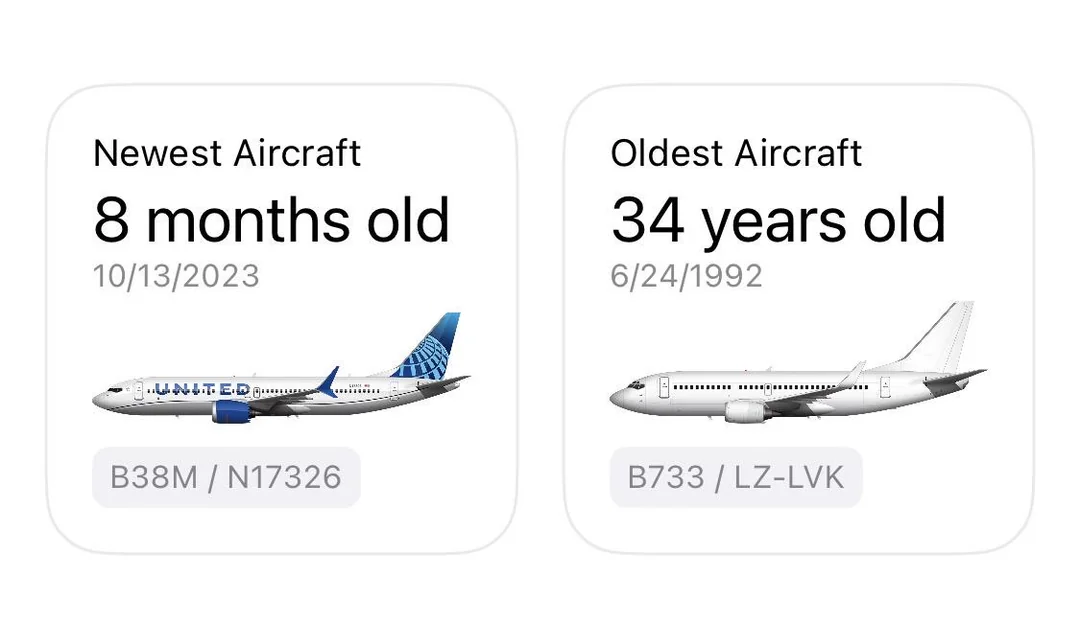
Aircraft age generally refers to the amount of time since a particular aircraft was manufactured or delivered.
For example, suppose an individual aircraft entered service in 2016 and you are flying in 2026. You might describe it as roughly ten years old.
But there are several dates you may encounter when researching aircraft:
| Aircraft Information | What It Means |
|---|---|
| Manufacturing date | When the aircraft was built |
| First flight | First time that individual aircraft flew |
| Delivery date | When it was delivered to an airline |
| Entry into service | When it began commercial operations |
| Registration date | When registered under a particular registration |
| Cabin refurbishment date | When its interior was significantly updated |
These dates are not necessarily identical.
For travelers, the first flight or delivery date is commonly useful for estimating aircraft age.
Aircraft Type and Aircraft Age Are Different
Before researching your flight, understand the difference between an aircraft type and an individual aircraft.
Your booking might say:
Airbus A350-900
That tells you the aircraft model currently scheduled for the flight.
It does not identify the individual airplane.
An airline might operate 20, 30, or more A350s. Some may have joined the fleet recently, while others could have been operating for years.
To determine the exact age, you need to identify which individual aircraft is scheduled.
That normally requires its registration.
What Is an Aircraft Registration?

An aircraft registration is essentially an airplane's unique identifying mark.
Think of it somewhat like a vehicle registration number, although aviation registration systems follow country specific formats.
The registration belongs to an individual aircraft rather than an entire aircraft model.
Once you identify the registration, you can potentially research information such as:
Aircraft model.
Variant.
Serial information.
Delivery history.
Previous operators.
Approximate age.
This is much more useful than searching only for something broad such as "Boeing 777 age."
Step 1: Find Your Airline and Flight Number
Start with the basic information from your reservation.
You need:
Operating airline
Flight number
Departure date
Departure and arrival airports
The operating airline is especially important on codeshare flights.
Suppose your ticket displays:
Airline A Flight 4500
Operated by Airline B
Airline B physically operates the aircraft.
Therefore, you need to investigate Airline B's aircraft rather than assuming Airline A provides the plane.
Step 2: Confirm the Scheduled Aircraft Type
Next, check which aircraft model is currently scheduled.
Open your reservation and look for wording such as:
Aircraft
Equipment
Plane type
Flight details
You might see:
Boeing 737-8.
Boeing 777-300ER.
Boeing 787-9.
Airbus A321neo.
Airbus A330-300.
Airbus A350-900.
This information gives you the aircraft family and variant, but it still does not tell you the age of the individual plane.
For that, you need the registration.
Step 3: Find the Aircraft Registration
This is often the hardest part when checking aircraft age in advance.
Airlines can schedule an aircraft type months ahead without committing a particular physical aircraft to the flight that early.
The exact aircraft registration may become visible through flight tracking information closer to departure.
For example, an airline may know that tomorrow's flight will use one particular aircraft because that aircraft is arriving from another destination beforehand.
Once the registration becomes available, write it down exactly.
That is the identifier you can use to investigate the individual airplane.
Step 4: Use Flight Tracking Information
Flight tracking services can be useful for identifying which individual aircraft is operating a flight.
Search using your operating flight number and travel date.
Depending on how close you are to departure and what information is available, you may be able to see:
Aircraft type.
Aircraft registration.
Previous flights.
Departure and arrival information.
Aircraft movement history.
The exact registration may not be available several weeks before departure.
Try checking again closer to the flight.
Even when a registration appears, remember that airlines can substitute another aircraft.
Step 5: Research the Registration
Once you have the aircraft registration, search that specific identifier in an aircraft database or aviation information source.
You may find information including:
Manufacturer.
Aircraft model.
Exact variant.
Manufacturer serial number.
First flight date.
Delivery date.
Current operator.
Previous operators.
Registration history.
If the aircraft's first flight or delivery date is available, calculating its approximate age is straightforward.
For example, an aircraft delivered in 2018 would be roughly eight years old in 2026, depending on the exact dates.
Step 6: Check the First Flight Date

The first flight date is one useful way of estimating aircraft age.
This refers to the first recorded flight of that particular airframe, usually before delivery to the airline.
Do not confuse this with the first flight of the aircraft model.
For example, an aircraft family may have existed for many years, while your individual aircraft could have been manufactured much more recently.
You want the history of the individual registration or serial number, not simply the history of the model.
Step 7: Check the Delivery Date
The delivery date is another useful reference.
This is when the aircraft was delivered to an airline or operator.
The first flight and delivery dates are usually relatively close, but not always identical.
Suppose you find:
First flight: March 2017
Delivered: May 2017
For ordinary travel research, you could reasonably describe the aircraft as having entered airline service around that period.
You do not need to calculate its age to the exact day unless you specifically want that level of detail.
Step 8: Check Whether the Aircraft Had Previous Operators
An airplane's current airline may not be its original owner or operator.
Aircraft can move between airlines.
Suppose an airline added an Airbus A330 to its fleet in 2023.
That does not necessarily mean the aircraft was manufactured in 2023.
It might previously have flown for another airline for several years.
If you want the aircraft's actual age, look at its manufacturing, first flight, or original delivery history rather than the date it joined the current carrier.
This distinction is particularly important when airlines acquire used aircraft.
Step 9: Use the Serial Number When Necessary
Aircraft registrations can change during an airplane's life.
For example, an aircraft moving between countries or operators may receive a different registration.
A manufacturer's serial number is tied more permanently to the individual airframe.
If your research becomes confusing because an aircraft has several previous registrations, the serial number can help trace its complete history.
For most casual travelers, the current registration is enough.
Aviation enthusiasts looking for detailed histories may find serial numbers particularly useful.
Step 10: Check the Previous Flight
One practical method close to departure is to determine where your aircraft is coming from.
Suppose your flight leaves at 8 p.m.
The aircraft scheduled to operate it may arrive at your airport at 5 p.m. on another service.
If the registration is available for that incoming flight, you may be able to identify the plane likely to operate yours.
This can be useful on the day of travel.
However, airlines can change aircraft rotations, so the incoming aircraft is not an absolute guarantee until operations actually unfold.
Common Mistakes When Checking Airplane Age
One common mistake is searching the age of the aircraft model rather than the individual airplane.
Another is researching the marketing airline on a codeshare instead of the operating carrier.
Travelers also sometimes assume that the date an aircraft joined its current airline is the date it was manufactured.
Another mistake is checking a registration several days before departure and treating it as guaranteed.
Most importantly, avoid assuming that an older aircraft is automatically unsafe or uncomfortable. Airframe age, maintenance condition, and cabin age are different things.
Frequently Asked Questions
Can I check exactly how old my airplane is?
Yes, if you can identify the individual aircraft registration and find reliable information about its first flight or delivery date.
Where can I find my aircraft registration?
It may appear in flight tracking information, particularly closer to departure. It is not always assigned or publicly visible far in advance.
Is the aircraft registration shown on my ticket?
Usually your passenger itinerary emphasizes the flight number and scheduled aircraft type rather than guaranteeing a specific registration.
Can an airline change the airplane before departure?
Yes. Airlines can substitute aircraft because of maintenance, scheduling, weather, fleet positioning, or other operational requirements.
Is a 20 year old aircraft unsafe?
Age alone does not determine whether a commercial aircraft is safe. Maintenance, inspections, regulatory requirements, and the aircraft's condition are much more relevant than age by itself.
Is aircraft age the same as cabin age?
No. Airlines can refurbish cabins, replace seats, and upgrade interiors during an aircraft's operating life.
How early can I identify my exact aircraft?
There is no universal timeframe. The scheduled aircraft type may be known far in advance, while the specific registration may only become apparent closer to departure.
Final Thoughts
If you want to check the age of an airplane before flying, start by identifying the operating airline, flight number, travel date, and scheduled aircraft type.
Then look for the aircraft's registration closer to departure.
Once you have that registration, you can research the individual airframe and find information such as its first flight, delivery date, previous operators, and approximate age.
Just remember that aircraft assignments can change.
The airplane showing against your flight today may not necessarily be the one waiting at your gate tomorrow.
And if you discover that your aircraft is older than expected, the number of years alone should not be treated as a measure of safety or passenger comfort. Commercial aircraft can remain in service for many years with ongoing inspections, maintenance, component replacement, and cabin upgrades.
For passengers, the most useful approach is to consider aircraft age, maintenance context, cabin configuration, and refurbishment history separately. That gives you a much clearer picture of the airplane you are actually likely to experience.
Some links on this page are affiliate links. If you book through one we may earn a commission, at no extra cost to you. It never affects our ratings, our rankings, or the price you pay.