How to Compare Aircraft Types Before Booking a Flight
When comparing flights, most travelers focus on price, departure time, baggage allowance, and the number of connections.
When comparing flights, most travelers focus on price, departure time, baggage allowance, and the number of connections. Those factors certainly matter, but there is another detail worth checking, especially when you are booking a long flight: the aircraft type.
Two flights operated by the same airline can provide noticeably different experiences because they use different aircraft. One may have a newer cabin, better business class layout, quieter interior, larger overhead bins, or a seating configuration you prefer. Another may simply offer a schedule that makes the slightly less attractive aircraft worthwhile.
Comparing aircraft does not mean choosing a flight based solely on whether it uses an Airbus or Boeing. The more useful approach is to examine the specific aircraft variant, airline configuration, seat map, and onboard product.
Here is how to compare aircraft types before booking your next flight.
Why Aircraft Type Matters When Booking

The aircraft influences the physical environment in which you will spend your flight.
Depending on the airline and configuration, aircraft differences can affect:
Seat layout and number of seats per row
Seat width and legroom
Premium economy availability
Business class configuration
First class availability
Cabin noise and atmosphere
Overhead storage
Entertainment equipment
Power and USB availability
WiFi availability
These differences become more significant as flight duration increases.
For a 60 minute journey, schedule and price may easily outweigh aircraft considerations. For a 12 hour overnight flight, cabin configuration can become much more important.
Aircraft Type vs Cabin Configuration
Before comparing planes, understand one important distinction.
Aircraft type tells you the model of airplane.
Cabin configuration tells you how an airline has arranged the interior.
For example, two airlines could both operate the same aircraft model but install completely different seating layouts.
One airline might configure economy with fewer seats per row or different seat spacing. Another might fit more seats into the cabin.
Business class can differ even more dramatically.
Therefore, never compare aircraft models without also checking how the specific airline has configured them.
Step 1: Find the Aircraft Type During Your Search
Start by expanding the detailed information for each flight you are considering.
Look for wording such as:
Aircraft
Equipment
Plane type
Flight details
You might find aircraft such as:
Airbus A320neo
Airbus A321neo
Airbus A330-300
Airbus A350-900
Boeing 737-8
Boeing 777-300ER
Boeing 787-9
Write down the exact model or variant rather than just "Airbus" or "Boeing."
An Airbus A320 and A350 are very different aircraft designed for different types of operations.
Step 2: Identify the Operating Airline
Before researching the aircraft, confirm which airline actually operates your flight.
This is especially important with codeshares.
Your search result might say:
Airline A Flight 4500
Operated by Airline B
Airline A is marketing the flight, but Airline B provides the aircraft and crew.
You therefore need to research Airline B's aircraft configuration.
Looking at Airline A's fleet or seat maps could give you completely incorrect information.
Always check the operating carrier for every segment before comparing aircraft.
Step 3: Compare the Exact Aircraft Variant
Do not stop at the aircraft family.
For example, you may encounter several versions within one family, such as different Boeing 787 variants or Airbus A350 variants.
These aircraft can differ in length, passenger capacity, cabin arrangement, and the number of seats installed by a particular airline.
The exact variant becomes particularly useful when comparing:
Premium cabins.
Economy layouts.
Number of rows.
Seat map.
Lavatory locations.
Aircraft capacity.
The more precisely you identify the aircraft, the easier it becomes to research the correct cabin.
Step 4: Open the Seat Map
The seat map is often more useful to passengers than the aircraft name itself.
Before booking, see whether the airline allows you to preview seat selection.
Look at:
Number of seats per row.
Number of economy rows.
Premium economy section.
Business class arrangement.
Exit rows.
Extra legroom sections.
Lavatories.
Galleys.
Bassinet positions.
A seat map can quickly show whether two aircraft provide significantly different layouts.
For example, two widebody aircraft may both serve the same route but have different economy seating arrangements.
Step 5: Compare Economy Seat Layouts
Economy travelers should pay particular attention to seating configuration.
Do not assume that a larger or newer aircraft automatically provides more personal space.
Airlines decide how many seats to install.
When comparing two flights, investigate:
Seat width: How wide is the seat?
Seat pitch: Roughly how much space is provided between rows?
Recline: Does the seat recline, and by how much?
Seats per row: How many passengers share each row?
Aisle access: How many seats separate you from an aisle?
On long flights, even modest differences in seating can influence comfort.
Step 6: Compare Premium Economy Cabins
If you are considering premium economy, aircraft type can become particularly important.
Not every aircraft in an airline's fleet necessarily has premium economy.
Even when the cabin exists, its size and location can differ.
Compare:
Seat width.
Seat pitch.
Recline.
Leg rests or footrests.
Cabin size.
Seat configuration.
Power availability.
Entertainment.
Also check whether the product is a genuine separate premium economy cabin rather than simply an economy seat with additional legroom.
Step 7: Compare Business Class Layouts

Aircraft research can provide the greatest value when booking business class.
Airlines sometimes operate several business class products within the same fleet.
Depending on the aircraft and configuration, you could encounter:
Direct aisle access.
Staggered seats.
Reverse herringbone layouts.
Older angled seats.
Fully flat beds.
Business suites with doors.
Different storage and privacy arrangements.
A traveler paying a substantial premium should not assume the words "business class" guarantee the same product on every aircraft.
Check the actual seat map and cabin description for your flight.
Step 8: Compare First Class Availability
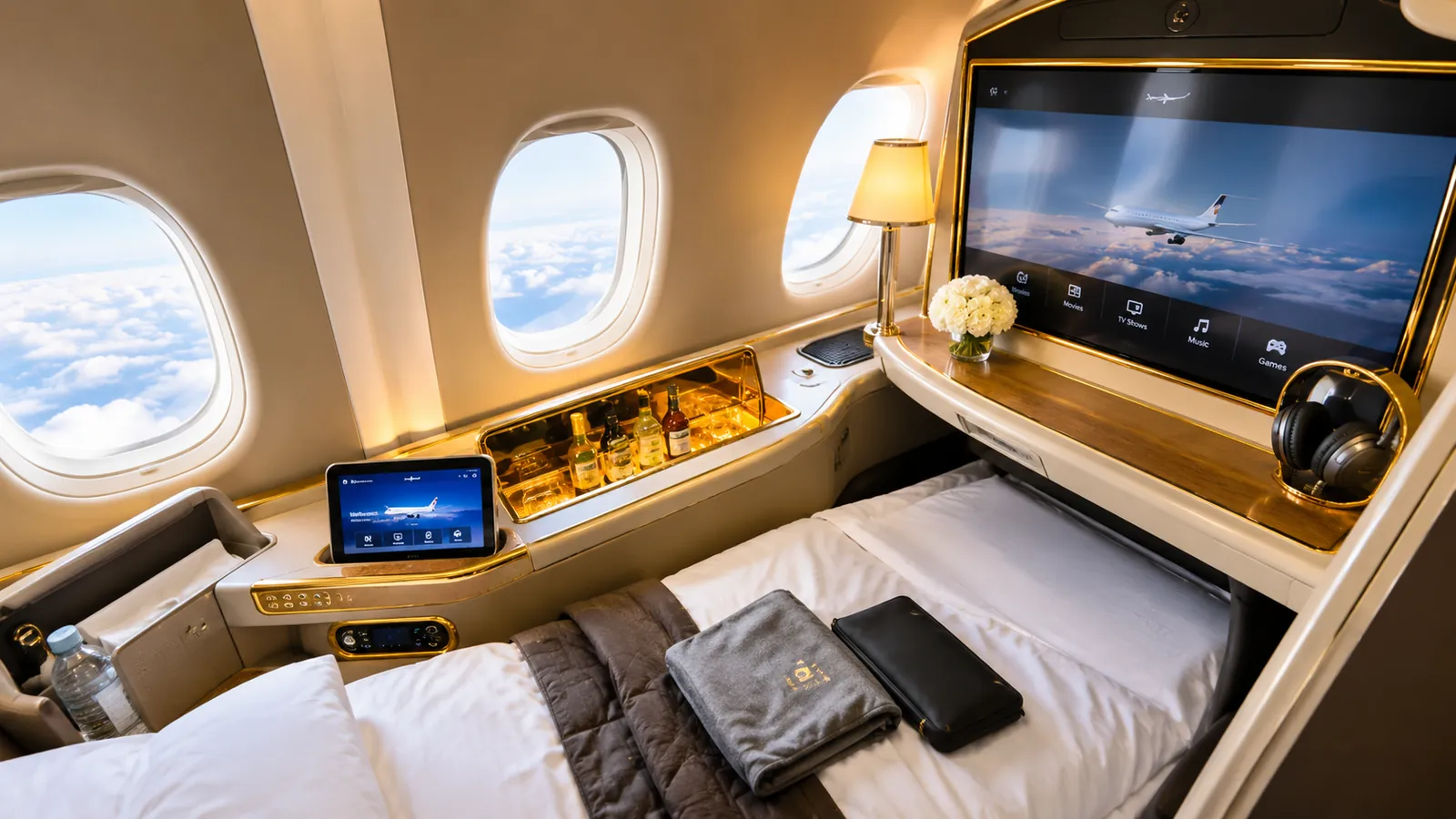
Some aircraft configurations include first class while others do not.
Even within one airline, first class may only be offered on selected aircraft and routes.
If you are booking or upgrading to first class, confirm that the flight actually has the product you expect.
Aircraft substitutions can also matter more in this situation because replacing one aircraft with another could potentially alter the premium cabin configuration.
Review the booking details carefully rather than relying only on general airline advertising.
Step 9: Compare Narrowbody and Widebody Aircraft
A useful basic distinction is between narrowbody and widebody aircraft.
| Feature | Narrowbody | Widebody |
|---|---|---|
| Main cabin aisles | Usually one | Usually two |
| Typical use | Short and medium haul, plus some longer routes | Common on long haul |
| Passenger capacity | Generally lower | Generally higher |
| Boarding | Smaller cabin | More passengers |
| Cabin sections | Usually fewer | Often more |
| Premium products | Varies considerably | Often broader on long haul |
This is only a general comparison.
Modern narrowbody aircraft can operate surprisingly long routes, while aircraft configuration remains airline specific.
A widebody is not automatically more comfortable. The seat layout matters.
Step 10: Compare Window and Middle Seat Options
The number of seats across a row can affect how convenient a flight feels.
If you are traveling as a couple, certain layouts may make it easier to sit together without having a third passenger directly beside you.
Families may prefer other configurations.
Solo travelers often care more about aisle access or window positioning.
When comparing aircraft, ask a practical question:
Where would I actually sit on each plane?
A theoretically better aircraft offers little advantage if the only seats remaining are ones you strongly dislike.
Step 11: Compare Cabin Noise and Environment
Some travelers specifically seek aircraft known for newer cabin technology or a more comfortable perceived environment.
However, avoid turning general aircraft characteristics into guarantees.
Where you sit can affect your experience.
Proximity to engines, galleys, lavatories, and high traffic areas can influence perceived noise and disturbance.
Rather than choosing an aircraft based on one advertised technical feature, combine aircraft information with the actual seat map.
For most passengers, seat location and configuration can be just as important as the aircraft model.
Step 12: Compare Entertainment and Connectivity
On a long flight, entertainment can matter almost as much as the seat.
Check whether your scheduled configuration offers:
Seatback entertainment.
Personal screens.
USB charging.
WiFi.
Bluetooth connectivity where offered.
Do not assume an aircraft family guarantees a particular entertainment system.
The airline chooses the cabin equipment, and individual aircraft can be refurbished at different times.
Check the airline's information for your scheduled configuration whenever possible.
Step 13: Consider Overhead Storage
Overhead storage matters if you travel with cabin baggage.
Some newer or refurbished interiors have redesigned overhead bins that can accommodate luggage more efficiently.
However, available space also depends heavily on how many passengers bring cabin bags and how the airline boards and manages them.
Aircraft type can provide some clues, but it should not be treated as a guarantee that your bag will fit overhead.
Always follow the airline's cabin baggage size and weight limits regardless of aircraft.
Step 14: Compare the Aircraft With the Schedule and Price
A preferred aircraft does not automatically make a flight the better booking.
Consider this illustrative comparison:
| Factor | Flight A | Flight B |
|---|---|---|
| Fare | $650 | $690 |
| Aircraft | Aircraft Type A | Aircraft Type B |
| Duration | 8h 30m | 8h 35m |
| Departure | 9:00 a.m. | 8:00 p.m. |
| Seat layout | Configuration A | Configuration B |
| Connection | None | None |
| Baggage | Included | Included |
Flight B might have the cabin you prefer, but Flight A could have a much better schedule.
The right choice depends on how much the aircraft difference matters compared with the rest of the itinerary.
Common Mistakes When Comparing Aircraft
The biggest mistake is comparing manufacturers instead of specific airline configurations.
Another is researching the marketing carrier rather than the airline actually operating a codeshare flight.
Travelers also sometimes assume every aircraft of the same model has an identical cabin.
Do not ignore the seat map, particularly in premium cabins.
Finally, avoid paying a large premium solely for a particular aircraft unless you are comfortable with the possibility of an aircraft swap.
The airline is selling transportation in a particular cabin and fare category, not necessarily guaranteeing one specific aircraft in every circumstance.
Frequently Asked Questions
How do I find the aircraft type before booking?
Expand the flight details and look for "Aircraft," "Equipment," or similar information. Availability varies by booking system.
Which is more important, aircraft type or seat configuration?
For passenger comfort, the airline's actual cabin and seat configuration is often more useful than the aircraft model alone.
Is a widebody always more comfortable than a narrowbody?
No. Comfort depends heavily on the airline's seating configuration, your seat, and the specific cabin.
Can the same aircraft model have different seats?
Yes. Different airlines configure the same aircraft differently, and a single airline can operate multiple configurations.
Should I choose a flight because it uses a newer aircraft?
Not automatically. Consider the cabin configuration, seat, schedule, fare, baggage, and connections as well.
Can my aircraft change after booking?
Yes. Airlines can substitute aircraft for operational reasons, including close to departure.
Is aircraft type worth checking for economy passengers?
Yes, particularly on long haul flights. Seat configuration, entertainment, power, and cabin layout can affect the overall experience.
Final Thoughts
Comparing aircraft before booking is most useful when you focus on the passenger experience rather than the name printed on the plane.
Start by identifying the operating airline and exact aircraft variant. Then check the seat map, cabin configuration, seat dimensions, premium cabin layout, entertainment, connectivity, and available seats.
For long haul travel, these details can meaningfully affect comfort. For shorter flights, price and schedule will often deserve greater weight.
Most importantly, remember that the scheduled aircraft can change.
Aircraft research should therefore be one part of your booking decision rather than the only factor.
Instead of asking, "Which aircraft is better?", ask, "Which flight gives me the best combination of aircraft configuration, seat, schedule, price, baggage, and overall itinerary?"
That approach will help you choose a flight based on the experience that actually matters once you are onboard.
Some links on this page are affiliate links. If you book through one we may earn a commission, at no extra cost to you. It never affects our ratings, our rankings, or the price you pay.