How to Tell If You Have a Self Transfer Flight
A self transfer flight can look almost identical to an ordinary connecting itinerary when you first see it in flight search results.
A self transfer flight can look almost identical to an ordinary connecting itinerary when you first see it in flight search results. You fly from your departure city to an intermediate airport, change planes, and continue to your final destination.
The important difference is what happens behind the scenes.
With a conventional connecting itinerary, your flights are generally linked together under a through ticket. With a self transfer, you are effectively connecting between separate travel arrangements yourself. That can mean collecting checked luggage, checking in again, passing through security, completing immigration formalities, and taking responsibility for reaching the next flight on time.
This distinction matters because a missed self transfer can have very different consequences from a missed protected connection.
Fortunately, there are several ways to identify one before you book. This guide explains how to tell if you have a self transfer flight, what warning signs to look for, and what to check before traveling.
What Is a Self Transfer Flight?

A self transfer itinerary combines flights that are not necessarily treated as one protected connecting journey by the airlines involved.
Imagine this route:
Flight 1: New York → London
Flight 2: London → Rome
With a normal through connection, the airlines may treat London as an intermediate point within one connected ticket.
With a self transfer, your New York to London flight and London to Rome flight may effectively be separate bookings.
You are responsible for transferring yourself between them.
That distinction can affect baggage, check in, immigration, terminal transfers, and what happens if Flight 1 arrives too late for Flight 2.
Self Transfer vs Regular Connecting Flight
The easiest way to understand the difference is side by side.
| Feature | Regular Through Connection | Self Transfer |
|---|---|---|
| Flights linked as one journey | Generally yes | Often no |
| Separate tickets possible | Less typical | Common |
| Recheck baggage | Depends on route | Often required |
| Check in again | Usually not for every segment | May be required |
| Missed connection handling | Generally connected under ticket conditions | May be your responsibility |
| Immigration during transfer | Route dependent | Often more likely if baggage must be collected |
| Extra transfer time needed | Normal connection buffer | Usually larger buffer |
| Booking references | May be one | May be multiple |
The exact procedures vary, so never rely on one characteristic alone.
1. Look for the Words "Self Transfer"
The most obvious sign is a warning during the booking process.
Flight search engines and travel booking platforms may label an itinerary with wording such as:
Self transfer
You must transfer yourself
Collect and recheck baggage
Check in separately
Connection not protected
The exact wording varies between booking services.
Do not treat this as a minor technical notice.
Open the itinerary details and read the transfer information before paying.
A low fare can look attractive because a search platform has combined independently available flights that traditional airline booking systems might not sell as one through itinerary.
2. Check Whether You Have Separate Tickets
Separate tickets are one of the strongest signs that you may be dealing with a self transfer.
Suppose you receive two independent ticket arrangements:
Ticket 1 covers:
Delhi → Bangkok
Ticket 2 covers:
Bangkok → Tokyo
The airlines may see these as two independent journeys rather than Delhi to Tokyo via Bangkok.
That matters if the first flight is delayed.
The second airline may simply see that you did not arrive for its flight on time.
Always determine whether your flights are issued together or separately rather than assuming that appearing on the same booking website makes them one protected journey.
3. Check Your Booking References

After booking, examine your confirmation carefully.
You may receive more than one airline booking reference or confirmation number.
Multiple booking references do not automatically prove that you have an unprotected self transfer because airline partnerships and booking systems can be complicated.
However, they are a reason to investigate further.
Check whether the booking confirmation explicitly describes the flights as separate tickets.
If you are uncertain, ask the seller or airline whether your journey is ticketed as a through itinerary and what happens if the first flight causes you to miss the next one.
4. Check Whether the Airlines Have a Ticketing Relationship
Seeing two different airlines does not automatically mean self transfer.
Many airlines cooperate through partnerships, interline arrangements, or codeshares.
You can therefore fly Airline A for the first segment and Airline B for the second while still traveling on a connected ticket.
The reverse is also true.
A booking platform can combine flights from two airlines that do not treat your journey as one protected connection.
Do not use the number of airline brands as your only test.
The more important question is whether the segments are actually ticketed and handled together.
5. Look for Baggage Recheck Instructions
Baggage instructions provide another important clue.
A self transfer may require you to collect your checked suitcase at the connecting airport and check it in again for the next flight.
Your process could look like this:
Land at connecting airport.
Leave the aircraft.
Complete immigration if required.
Go to baggage claim.
Collect suitcase.
Complete customs procedures where applicable.
Reach the next airline's check in area.
Check suitcase again.
Pass security.
Complete departure formalities.
Reach your gate.
That is far more involved than simply walking between gates.
However, baggage collection can also be required on some ordinary through itineraries because of local procedures. It is a warning sign, not absolute proof by itself.
6. Check Whether You Must Check In Again
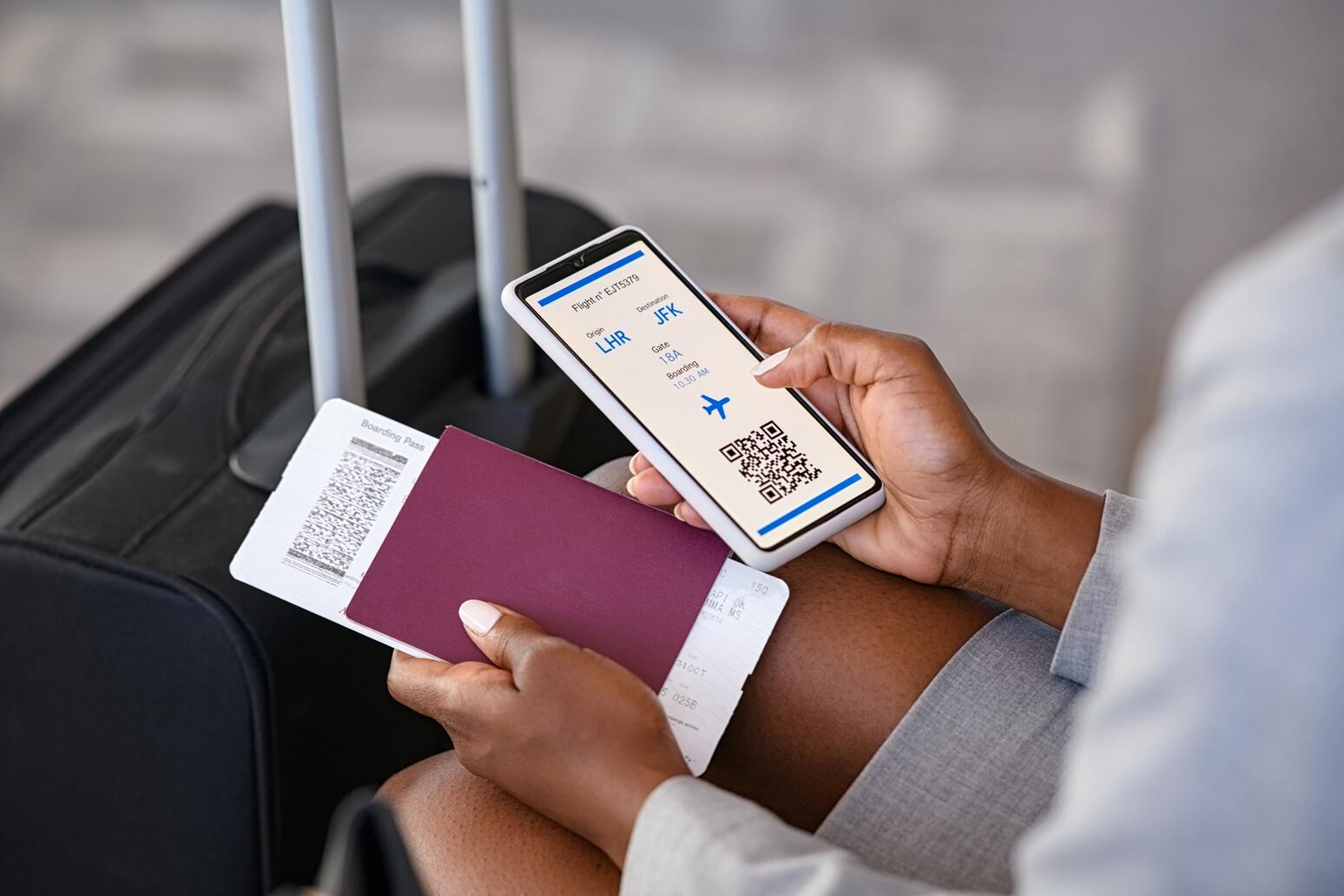
If the booking tells you to check in separately for each flight, investigate whether the itinerary is self transfer.
With separate tickets, Airline B may have no operational connection to your arrival on Airline A.
You may therefore need a new boarding pass and separate check in process.
Online check in might simplify this when available, especially if you have only cabin baggage.
But having a boarding pass does not necessarily eliminate immigration, security, or other transfer requirements.
Always follow the procedures applicable to your specific airport and itinerary.
7. Check Your E Ticket Information
Your e ticket confirmation can reveal useful information.
Look at how the journey is presented.
Are all segments shown together under one ticket arrangement, or do you have separate ticket confirmations for different parts?
Do not focus only on whether the flights were purchased in one payment.
Paying once on a travel website does not necessarily mean the airlines issued one through ticket.
A booking platform can sell multiple tickets within a single transaction.
The airline ticketing arrangement matters more than the number of credit card payments.
8. Watch for Unrelated Airlines
A combination of airlines that do not normally sell connecting itineraries together can be another warning sign.
For example, a search website might combine a low cost carrier for the first flight with another independent carrier for the second.
That combination can produce an excellent fare, but it may require a self transfer.
Again, different airlines alone do not prove anything.
Instead, use this as a signal to check ticketing, baggage, and missed connection arrangements more carefully.
9. Look for Airport or Terminal Changes
Some self transfer itineraries involve changing terminals or even airports.
A terminal change might require you to leave the secure area, use ground transportation, and pass security again.
Changing airports is much more significant.
Imagine arriving at one airport and departing from another airport serving the same city.
You now need enough time for:
Arrival procedures.
Baggage collection.
Ground transportation.
Traffic delays.
Check in.
Baggage drop.
Security.
Departure formalities.
A flight search result may still present this as one itinerary, so always check airport codes carefully.
10. Check Whether You Need to Enter the Connecting Country
This is particularly important internationally.
A conventional airside transit may allow eligible passengers to remain within the international transfer area.
A self transfer can sometimes require entering the country because you need to collect baggage or reach the public check in area.
That can change your documentation requirements.
Depending on your nationality, destination, and connecting country, you may require permission to enter even though you only intend to continue to another flight.
Never assume that "I am only connecting" means entry requirements cannot apply.
Verify the current rules that apply to your exact itinerary before travel.
11. Check the Missed Connection Terms
One of the clearest ways to understand your itinerary is to ask what happens if the first flight is late.
Suppose Flight A should arrive at 2 p.m. and Flight B departs at 5 p.m.
Flight A is delayed until 4:30 p.m., causing you to miss Flight B.
On a through itinerary, the onward segment is generally treated as part of your connected journey, subject to applicable ticket conditions and circumstances.
With an independently ticketed self transfer, Airline B may have no responsibility for Flight A's delay.
You could be treated as a no show.
Some booking services sell additional connection guarantees or protection products, but their terms vary and should not be confused automatically with airline through ticket protection.
12. Do Not Assume a Long Layover Means It Is Protected
A five hour connection can still be a self transfer.
Likewise, a relatively short connection may be sold as part of a conventional through ticket.
Connection duration does not determine ticket status.
Search platforms sometimes create generous layovers specifically because passengers need enough time to complete self transfer procedures.
Always check the actual ticket arrangement rather than trying to identify a self transfer from layover length alone.
13. Calculate Enough Time for the Self Transfer
If you knowingly choose a self transfer, give yourself substantially more time than you would for a simple gate to gate connection.
Consider all potential steps:
| Transfer Requirement | Why It Takes Time |
|---|---|
| Immigration | Queues can vary |
| Baggage collection | Bags may take time to arrive |
| Customs | Procedures vary |
| Terminal transfer | May require walking or transport |
| Airport transfer | Traffic can be unpredictable |
| Check in | Deadlines apply |
| Baggage drop | Can involve queues |
| Security | Waiting times vary |
| Immigration departure control | May apply |
| Walk to gate | Large airports take time |
Also include a buffer for the first flight arriving late.
For some separate ticket journeys, an overnight connection may be more sensible than a tight same day transfer.
14. Check Baggage Rules for Both Flights
Self transfers can also create baggage problems even when you make the connection successfully.
The two airlines may have different allowances.
For example, Airline A might allow a cabin bag that Airline B considers too large or heavy.
Checked baggage limits can also differ.
Compare each flight separately for:
Cabin baggage dimensions.
Cabin baggage weight.
Checked baggage allowance.
Extra bag fees.
Overweight charges.
Baggage check in deadlines.
The rules from your first flight do not automatically carry over to the second.
15. Be Careful With No Show Rules
Missing the second flight can have consequences beyond purchasing another ticket.
If the missed flight belongs to a larger ticket containing later segments, airline no show rules may affect those remaining flights depending on the fare and ticket conditions.
This is another reason to understand exactly how your journey has been ticketed.
Do not simply buy another flight without first checking the status of any remaining segments in your reservation.
Contact the relevant airline or booking provider when necessary.
16. Self Transfer With Cabin Baggage Only
Traveling without checked luggage can make some self transfers easier.
You may avoid baggage claim and baggage recheck.
If you can obtain your onward boarding pass online and remain eligible to follow the appropriate transfer route, the process may be much quicker.
But cabin baggage does not automatically turn separate tickets into a protected connection.
If the first flight arrives late and you miss the independently ticketed second flight, the underlying ticketing problem remains.
It also does not automatically remove immigration or visa requirements.
17. Questions to Ask Before Booking
Before purchasing an itinerary that might involve self transfer, check these points:
| Question | Why It Matters |
|---|---|
| Are the flights on separate tickets? | Reveals connection structure |
| Must I collect baggage? | Adds significant transfer time |
| Must I check in again? | May require entering departures |
| Do I change terminals? | Adds transfer complexity |
| Do I change airports? | Requires ground transportation |
| Must I pass immigration? | Entry rules may apply |
| What if Flight 1 is late? | Shows missed connection risk |
| How much buffer do I have? | Determines practicality |
| Are later flights available? | Useful if plans go wrong |
If the booking page does not answer these questions clearly, investigate before paying.
Common Self Transfer Mistakes
The biggest mistake is assuming that flights purchased together are automatically one protected itinerary.
Another is assuming different airlines always mean self transfer. They do not.
Travelers also underestimate how long baggage collection, immigration, terminal changes, and security can take.
A particularly risky mistake is choosing a short self transfer because the airport looks small on a map.
Finally, some passengers focus on saving money without considering the financial consequences of missing the onward flight.
A cheaper itinerary is valuable only when the additional complexity and risk make sense for your trip.
Frequently Asked Questions
How do I know if my flight is self transfer?
Look for self transfer warnings, separate tickets, baggage recheck instructions, separate check in requirements, multiple booking arrangements, and missed connection conditions.
Does having two airlines mean self transfer?
No. Different airlines can cooperate and issue connected itineraries. Check the ticket structure rather than airline names alone.
Do I have to collect baggage on a self transfer?
Often, but not always. Check the instructions for your specific booking and connecting airport.
Is self transfer the same as separate tickets?
Self transfers commonly involve separate tickets, but always confirm how your specific itinerary has been issued.
What happens if I miss a self transfer flight?
If the onward flight is independently ticketed, the next airline may treat you as a no show. Any booking platform protection depends on its specific terms.
Do I need a visa for a self transfer?
Possibly. If the transfer requires you to enter the connecting country, applicable entry requirements may apply. This depends on nationality, route, and local rules.
Are self transfer flights worth booking?
They can provide lower fares or useful routing options, but you should weigh those benefits against additional transfer time, baggage handling, documentation requirements, and missed connection risk.
Final Thoughts
The easiest way to tell whether you have a self transfer flight is to look beyond the route displayed in the search results and examine how the flights are actually ticketed and connected.
Look for explicit self transfer or separate ticket warnings. Check whether you need to collect and recheck baggage, obtain another boarding pass, change terminals or airports, and pass through immigration.
Most importantly, find out what happens if your first flight is delayed.
A single payment, one booking website, or two flights appearing on the same itinerary does not necessarily mean the airlines consider them one protected journey.
If you deliberately choose a self transfer, build a generous buffer and understand the airport procedures before departure.
Once you know exactly where one ticket ends and the next begins, you can judge whether the potential saving is worth the additional responsibility and choose your itinerary with far fewer surprises.
Some links on this page are affiliate links. If you book through one we may earn a commission, at no extra cost to you. It never affects our ratings, our rankings, or the price you pay.